
Leadership Clarity in Automotive
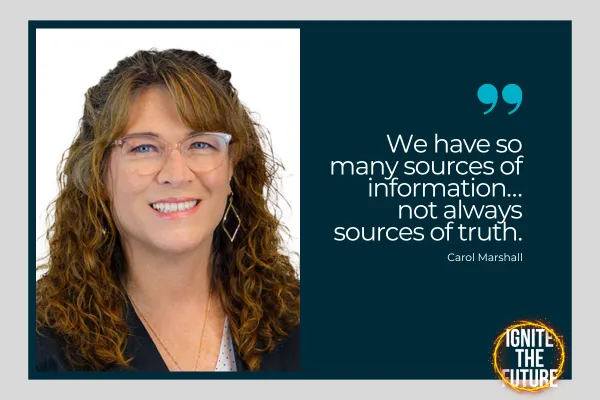
How Carol Marshall Helps Teams Cut Through the Noise
Every day, someone is telling you the sky is falling. AI is coming for your job. The market is shifting. Consumer expectations have changed again. A new tool will solve everything. An expert you've never heard of has a prediction you can't afford to ignore. The volume is relentless, and for leaders in automotive, the pressure to react to every new wave of information is enormous.
Carol Marshall has been watching these waves for 30 years. She was there when the internet arrived and dealers agonized over whether to put pricing on their websites. She was there when leads got faxed in and consumers were called "cyber grinders" because they'd fight you over a nickel. She was there when COVID turned salespeople into order-takers and nobody noticed the skills gap it created until the orders stopped coming. And she's here now, watching AI dominate every conference stage and every LinkedIn feed, and asking the question that steady leaders always ask: how much of this is real, and how much of it is noise?
Carol is the COO of ActivEngage, employee number seven at a company she's helped build over 17 years from 30 dealers to a national operation. She got into the industry the way most people do: by accident. She went to a job fair to get information for a neighbor who wanted to work at AutoNation. She had to talk to someone to get the details, and they ended up hiring her instead. From there, she became a General Sales Manager, then the company's first district E-Commerce Manager, then a corporate leader who traveled the country building internet policies and hiring strategies. A stint at Mazda's Southeast regional office gave her the OEM perspective. And through all of it, three kids under five kept things interesting at home. Her Breakout Session at the 2026 Women In Automotive Annual Conference, July 17-20 in Austin, TX, "Moments of Truth: Dispelling Hype to Deliver Positive Outcomes," is a leadership session for anyone who is tired of being rushed into decisions by the loudest voice in the room.
The 20-Year Swing Nobody Saw Coming
Carol has a perspective that only three decades of watching the same industry reinvent itself can give you. She remembers standing in a Chrysler dealership when the team lost a deal over 50 cents. That was the era. Consumers shopped price first, negotiated everything, and the dealership that won was often the one willing to lose the most margin. The entire industry was built around that dynamic.
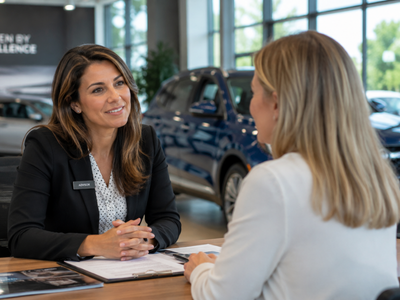
Today, the opposite is true. "We know millennials and Gen Z will pay more for a good experience," Carol said. They want the white-glove treatment. They want to be heard and seen. They care less about grinding for the last dollar and more about how the interaction made them feel. That is a 20-year swing from transactional to relational, and the dealerships that haven't made the turn are still operating with a playbook designed for a customer who no longer exists.
The challenge isn't just strategic. It's operational. Many of the people on today's sales floors came up during COVID, when the job was taking orders, not selling. And younger employees often haven't experienced proactive, exceptional service themselves, which means they can't deliver what they've never seen. Carol points to Shep Hyken's Be Amazing or Go Home as a resource that's been instrumental at ActivEngage for helping teams understand what proactive service actually looks like in practice. You can't assume people know. You have to teach it.
The Language of Specificity
If there's a single operational principle Carol returns to more than any other, it's clarity. She reads Henry J. Evans' Winning with Accountability with her team every January, and the concept that anchors everything is what Evans calls "the language of specificity."
Carol's version is practical and immediate. When she assigns something to her team, the best response she can get isn't "okay." It's a clarifying question. "And when would you like that by?" or "Do you want it in this format or this format?" or "Do you want me to distribute here or here?" Those questions save time, protect energy, and prevent the demoralizing moment when someone works on something for four days and delivers something completely different from what was expected.
"It's not only my responsibility as the sender to set clear expectations," Carol said. "It's your responsibility as the receiver." Think about the last time you asked someone on your team for something, assumed it was clear, and got back something completely different four days later. The frustration you felt in that moment was real. But so was the frustration on the other side, from someone who worked hard on something and was told it missed the mark. That shared ownership of clarity is what high-performing teams look like in practice. And it works in both directions, inside the organization and in every customer conversation happening on dealer websites. The teams asking the best clarifying questions are the ones creating the best experiences, because a customer who came in looking for one vehicle might need something entirely different once the right questions open the conversation.
If your team isn't asking clarifying questions, it's not a skills problem. It's a culture problem. And fixing it starts with making it safe to ask.
People Come to Work Wanting to Succeed

Carol's leadership philosophy starts with an assumption most managers skip: positive intent. Everyone who shows up to work wants to have impact. Everyone wants to feel like they're doing good work. When that's not happening, the leader's first job is to investigate, not judge.
"Nobody wants to be a non-performer," Carol said. When someone is underperforming, there's almost always a reason. Maybe the expectations were never clear. Maybe the training didn't happen. Maybe something outside of work is affecting their capacity. The leaders who assume the worst and react accordingly lose people who could have been saved by a conversation. The ones who start with curiosity and hold the standard without losing their humanity build teams that stay.
That balance between empathy and accountability is central to Carol's approach. She frames it with a principle that's deceptively simple: protect the organization as if it is a person. Compassion for individuals matters. So does the health of the team, the culture, and the business. One cannot suffer indefinitely because of the other.
You Can't Draw From a Dry Well
Carol connects employee experience and customer experience with a directness that should be obvious but isn't always practiced. "You can't draw from a dry well," she said. If your team is burned out, emotionally exhausted, or operating in a culture that takes more than it gives, the customer will feel it. Not because anyone is being unprofessional. Because human energy has limits, and a team running on empty cannot deliver the kind of experience that today's consumers expect.
And if you're reading this and recognizing yourself as the dry well, not just managing one, Carol sees that too. The leader who is pouring into her team, her customers, and her organization while no one is pouring into her is the leader most at risk of quiet erosion. This is where the internal work and the external work become the same work. The dealership investing in its culture, in clarity, in development, in making people feel valued, is also the dealership delivering the experience that wins customers. The one that treats its employees like replaceable parts will eventually deliver an experience that feels like it.

If You Want Me to Do Nothing, Rush Me
Carol's most quotable line might also be her most important leadership principle. "If you want me to do nothing, rush me," she said, laughing. But she means it. In an industry addicted to urgency, where every new technology, every market shift, every expert prediction demands immediate action, Carol's approach is deliberately countercultural. She takes her time. She asks questions. She verifies before she acts.
Her AI billionaire analogy captures the point perfectly. The loudest voices predicting that AI will transform everything are AI billionaires who own AI companies. "Can you imagine if manufacturers were out there saying everyone should have a vehicle?" Carol asked. "In fact, we should lower the driving age to 10 and every 10-year-old should have a vehicle." The absurdity makes the point. Not every loud message deserves immediate action. And the strongest leaders are often the least reactive people in the room.
This is not an anti-AI position. Carol uses technology daily and understands its value. It's an anti-reactivity position. The leaders who pause, question, and come to their own conclusions will always outperform the ones who get carried by every wave that comes through.
One Call, One Conversation, Better Outcomes
Carol is also pushing a vision for how the vendor side of automotive can better serve dealers. At the Dealer Profitability Summit earlier this year, a dealer described a practice that resonated deeply with her: instead of taking ten separate calls with ten different vendors, he consolidates them into one call. All of his vendor partners join the same conversation, hear the same priorities, and are expected to collaborate with each other to deliver results.
It saves the dealer time. It forces vendors to communicate with each other in the language of the industry rather than expecting the dealer to translate between them. And it creates accountability that isolated vendor relationships can't replicate. ActivEngage is actively pursuing this approach with partner vendors who share clients, and Carol sees it as the future of how the industry should operate.
A Session for Leaders Who Are Tired of Being Rushed

Carol designed her session for anyone in automotive leadership who feels the pressure to react to everything and the suspicion that not everything deserves a reaction. Attendees will leave with practical tools for clearer thinking, stronger leadership communication, and the confidence to slow down when the industry is telling them to speed up.
"You don't have to be carried anywhere," Carol said. "You can step out of the way, watch it, do your own research, ask your own questions, and come to your own conclusion."
The industry will keep changing. The predictions will keep coming. The noise will only get louder. But the leaders who stay steady, who question before they react, and who lead with clarity instead of urgency will always find their footing. If you've been feeling the pressure to have an answer for every new disruption, every market shift, every expert prediction, Carol's session is permission to take a breath and lead from your own discernment instead of someone else's urgency.
Join Carol Marshall at the 2026 Women In Automotive Annual Conference, July 17-20 in Austin, TX, for "Moments of Truth: Dispelling Hype to Deliver Positive Outcomes." Register today, and learn to lead from your own conclusion instead of someone else's headline.