Emotional Intelligence in Automotive Leadership
The Skill That Separates Good Leaders From Great Ones
You're on your way to work, already running through the meeting agenda in your head, when your child announces from the backseat that he was supposed to bring cupcakes today. Now you're in a grocery store parking lot at 7:45 a.m., mentally rewriting your morning, and by the time you walk into that 8 o'clock meeting, you're carrying an emotion that has nothing to do with the people in the room, but everything to do with how you're about to show up in it.
Dr. Martha Rader calls this the invisible entrance. "Your emotions show up in a room before you do," she said. And if you don't understand that if you haven't built the awareness to recognize what you're carrying, and how it's affecting the people around you, you're leading with a blind spot that no amount of technical skill can compensate for.

"People are messy," Martha said. "We all are, every one of us." She doesn't say it as a criticism. She says it as a starting point; the honest foundation that everything else in her work is built on. If you can accept that, you can start doing something about it. If you can't, you'll keep wondering why your leadership isn't landing the way you think it should.
Martha is the CEO of Rader Leadership and a Women In Automotive Board member and this year a Breakout Session at the WIA 2026 Annual Conference speaker whose career in automotive stretches from the filing room to the executive suite. She spent years at GMAC Financial Services, starting at the lowest rung and rising to an executive position. At 32, she was one of the original in-dealership lease trainers for GM; a young woman walking into dealerships full of skepticism and earning the room anyway. Today, she describes her work through a philosophy she borrowed from a client: the first half of your career is about success, and the second half is about significance. Martha is firmly in the significance phase. Her Breakout Session at the 2026 Women In Automotive Annual Conference, July 17–20 in Austin, TX "Discover Your EQ Superpowers and Kryptonite: Assess, Reflect, Rise", is built around a conviction she's carried through every phase of that career: emotional intelligence isn't a soft skill. It's the skill that determines whether everything else you've built actually works.
Your Strengths Are Also Your Vulnerabilities

The superpowers-and-kryptonite framework didn't originate with Martha; she'll tell you that honestly. A construction company CEO she was coaching used the language to describe what he saw in his own leadership, and Martha immediately recognized its power. "I'm stealing that," she told him. The metaphor stuck because it captures something most leadership training misses: your greatest strengths, overused or unmanaged, become the very things that undermine you.
A leader who is naturally decisive becomes domineering under pressure. A leader who is naturally empathetic becomes conflict-avoidant when the stakes rise. A leader who is composed and measured gets perceived as cold or disengaged when the team needs warmth. The superpower doesn't disappear; it tips over into its shadow. And most people don't see it happening because nobody has taught them to look.
You probably recognized yourself in one of those descriptions. Maybe more than one. That flash of recognition, the one you just felt, is exactly the starting point Martha's session is designed to build on.
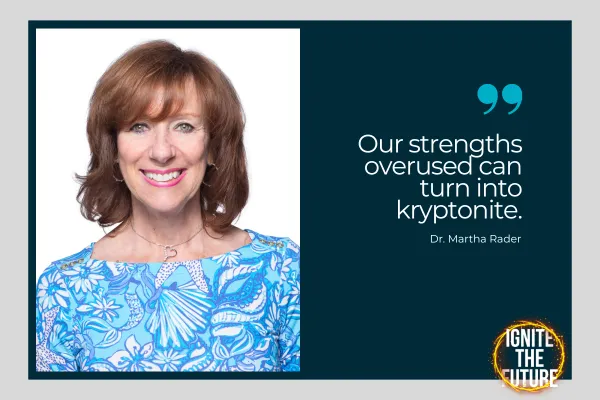
"Our strengths overused can turn into kryptonite by taking away some of our superpowers," Martha said. Her session is designed to help attendees identify exactly where that tipping point lives for them, not in theory, but in the specific, recognizable patterns of their own leadership.
The Double Standard Women Know Too Well
For women in automotive, emotional intelligence carries an additional layer of complexity that Martha doesn't shy away from naming. The double standard around assertiveness, where the same behavior that earns a man respect earns a woman a label, isn't just frustrating. It's an EQ challenge that requires a level of self-management most male colleagues never have to develop.
Martha has lived it. Early in her career, a superior called her aggressive. Her response was immediate: "If I was a man, I'd be assertive." It didn't go over well, and she'll be the first to admit the delivery was a lapse in self-control; even though the observation was completely accurate.

That moment captures the tension women in leadership navigate constantly: the gap between what you know to be true and what the room is ready to hear. You've sat in that chair. You've watched your tone while a colleague said the same thing louder and got praised for his conviction. You've calculated, in real time, whether the cost of speaking up is worth the label it might earn you. Emotional intelligence doesn't mean suppressing that truth. It means understanding the room, reading the moment, and choosing how to deliver it in a way that lands without diminishing you. It's a that skill women in automotive are forced to develop whether they want to or not. Martha's argument is that developing it intentionally, rather than reactively, is what separates the leaders who burn out from the ones who break through.
What Happens When You Don't Deal With It
Martha is direct about the cost of emotional blind spots, and she has the research to back it up. Studies show that a single emotional trigger can create a hangover that
affects performance for up to four hours. Martha laughs at that number. "I don't know about you, but I've carried them for two weeks or longer."
That resonates because it's true. The meeting where you were talked over. The feedback that felt unfair. The moment when you held back something important because the risk of being labeled felt greater than the reward of being heard. Those experiences don't evaporate when the meeting ends. They compound. They erode your presence, your performance, and your willingness to engage. And they affect the people around you in ways you may not realize.

"Unless we know what those things are," Martha said, "they may be a lot less productive. Maybe they don't know what they're doing. Maybe they need help." The cost of low emotional intelligence isn't just personal. It's organizational; disengaged teams, unresolved conflict, and the slow erosion of trust that makes high-performing cultures impossible to sustain.
The Statistic That Should Change How You Think About Leadership
Martha shares a number that reframes the entire conversation: studies indicate that 80 to 90 percent of top-performing leaders' success can be attributed to emotional intelligence. Not technical expertise. Not industry knowledge. Not years of experience. Emotional intelligence.
That statistic isn't in her session; she shared it in conversation because it illustrates why EQ development isn't optional for leaders who want to operate at the highest level. If nine out of ten things that make your best leaders effective are rooted in how they manage themselves and connect with others, then every other investment in leadership development is building on a foundation that may or may not exist.
The industry has historically valued operational excellence, product knowledge, and results above all else. Martha isn't arguing those things don't matter. She's arguing they're insufficient without the emotional infrastructure to lead people through complexity, change, and pressure, all of which automotive is experiencing at an unprecedented pace.
Why This Matters More Right Now Than Ever
Martha connects emotional intelligence directly to the challenge every automotive leader is facing: change. AI, digital transformation, shifting consumer expectations, the pace is relentless, and the people expected to execute it are overwhelmed.
"We can no longer say, you just have to do it," Martha said. "The buck stops right there." Leaders who lack empathy, who can't read their teams, who default to authority instead of influence, will stall every transformation they touch. The organizations that navigate change successfully aren't the ones with the best technology. They're the ones with leaders who know how to bring people with them.

A Session You'll Feel, Not Just Hear
Martha designed her session as an interactive lab, not a lecture. Attendees will take a mini self-assessment, identify their EQ superpowers and kryptonite in real time, and then do something most leadership sessions skip: talk to the person next to them about what they found.
"When you interact with the person next to you and say something about your superpower or your weakness, it starts to feel real," Martha said. "It's not just me."
Martha's message for anyone who feels emotional intelligence isn't their natural strength is simple: "Anyone can if they're intentional about it." EQ isn't a personality trait you're born with or without. It's a skill, and like any skill, it develops through focus, practice, and feedback. Martha knows because she's done the work herself, including sending a weekly Survey Monkey to her colleagues asking them to rate how she was doing on the specific EQ skill she was developing. That level of vulnerability takes courage. It also works. And it's the kind of practical, specific, gutsy step that most leadership sessions would never ask you to consider.
You don't have to fix everything at once. You just have to start with the one thing that's costing you the most. And for women navigating the emotional demands of leadership while protecting their energy, Martha's session pairs naturally with Dara Koenig's session on avoiding burnout, one to understand the patterns, the other to make sure they don't consume you.
Here's what matters most about Martha's session: you can't get this from a recording. The self-assessment, the moment you see your kryptonite on paper, the conversation with the woman next to you who admits she has the same blind spot, that only happens if you're in the room. And that shared recognition is where the real shift begins.
Join Dr. Martha Rader at the 2026 Women In Automotive Annual Conference, July 17–20 in Austin, TX, for "Discover Your EQ Superpowers and Kryptonite: Assess, Reflect, Rise." Register today, and find out what's been your greatest strength and your biggest blind spot all along.