
Authentic Leadership in Automotive 2026
Why Joy and Purpose Drive Better Leaders
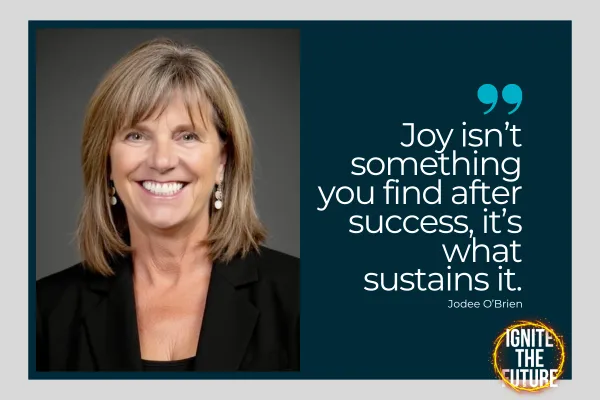
There’s a word that rarely makes it into leadership conversations in the automotive industry. It doesn’t show up in KPI reports or performance reviews. It’s not on the agenda for your next manager meeting, and it’s almost certainly not something you’ve been coached on. The word is joy—and according to Jodee O’Brien, the General Session keynote speaker for the 2026 Women In Automotive Annual Conference, ignoring it might be costing you more than you realize.
Jodee O’Brien is one of the owners of ActionCOACH Central Texas, a business she runs alongside her husband and son. She brings more than 35 years of experience spanning business and nonprofit leadership, and she has spent much of that career doing something that isn’t always rewarded in high-stakes industries: being honest about what it really takes to lead well and lead long. When she steps onto the General Session stage this July, she’ll be delivering a keynote called Laugh, Lead, and Legacy—and if the conversation she brings to the room is anything like the one she brings everywhere else, attendees should plan to leave with a perspective they didn’t walk in with.
Joy Isn’t the Reward. It’s the Fuel—and Your Competitive Edge as a Leader
Here’s the version of success we’ve been sold: work hard, push through, hit the goals, and the good stuff will come afterward. Joy is the prize at the end—the thing you get to feel once you’ve earned it. It’s a compelling story. It’s also, Jodee says, exactly backward.

“People think about joy as kind of the after effect,” she explains. “But really, joy is what’s going to fuel your legacy and fuel your leadership. It’s finding that joy in what you’re doing, and then figuring out how to bring that out in your work and personal life.”
This isn’t a motivational platitude. It’s a practical observation about sustainability. Leaders who run on pressure and adrenaline eventually run out of both. Leaders who stay connected to what genuinely energizes them—who can identify where in their work they lose track of time, where they feel lit up rather than depleted—have access to something renewable. And in an industry as demanding as automotive, that distinction matters.
Jodee challenges her audiences to ask a simple question: where do I lose time? Not where do I get the most done, not where do I perform the best under pressure, but where does time disappear because you’re so absorbed in what you’re doing that you stop watching the clock? “That’s where you’re going to find your joy,” she says. “It may be certain aspects of your job—and knowing which is more fulfilling, then either trying to get more of that and delegate the other stuff, or just figure out: that’s what feels good. How can I move that forward?”
This is what makes joy a competitive advantage rather than a luxury. When leaders understand what fuels them, they make better decisions about where to invest their energy, how to structure their teams, and what to let go of. When they ignore it, they risk something Jodee describes as one of the quieter leadership crises: losing yourself in the role.
Ask yourself: where do I lose time? That’s where your joy lives—and where your strongest leadership lives too.

The Permission to Be Fully Yourself at Work: Why Authentic Leadership Wins
Women in automotive know this tension well. There is an unspoken expectation in many professional environments—and it runs especially deep in male-dominated industries— that to be taken seriously, you must appear serious. Emotion is a liability. Humor is a distraction. Vulnerability is a risk you can’t afford to take. So leaders perform a version of themselves that looks the part, and somewhere along the way, the performance starts to feel like the whole job.
Jodee doesn’t accept this trade-off.
“I think it really goes back to allowing yourself to be silly. Allowing yourself to be yourself. Having the inspiration and the confidence to say, you know what, this is who I am.” She acknowledges the pressure women in particular face: “Women…can’t show their emotions because then it’s taken away from them. So I think being able to find that confidence in letting your emotions lead—in a good way.”
She’s not suggesting that emotion replaces professionalism. She’s suggesting that confidence actually comes from the opposite direction than most leadership training implies. Instead of projecting certainty, projecting distance, projecting someone who has everything under control, genuine confidence comes from being fully yourself—and trusting that who you are is enough. “Crying does not mean you don’t matter,” she says simply. “It’s just how I’m responding.”
There’s a related practice she calls laughing at the mess, and it’s one of the most practical reframes in her leadership toolkit. When something goes sideways—when the plan falls apart, when the numbers don’t land, when a meeting goes off the rails— leaders have a habit of treating every setback as a referendum on their competence. Jodee offers a different option: pause, ask whether this is actually going to matter in six months, and if the honest answer is no, give yourself permission to find it a little funny. “You can look back at something and laugh,” she says. “But if you can bring that forward in the moment and just be like—okay, is this really something that’s going to make or break my career? No one’s going to die if this doesn’t happen.” Perspective, it turns out, is a skill. And it can be learned.
Your difference is your strength. The traits you’ve been told to dial back—your emotion, your warmth, your humor—are often the exact qualities that make people want to follow you.
Leading with Purpose, Not Pressure: The Mindset Shift Women Leaders Need
One of the sharpest distinctions in Jodee’s keynote is the gap between leaders who are reactive and leaders who are intentional. She describes it as fighting fires: “If you’re leading with pressure, you’re so busy reacting. You’re not really taking the deep look of—is this going in the direction I want it to go? You get the task done, but it really was more of a meh—I got it done—and not a wow, I really accomplished something meaningful.”

Pressure-driven leadership isn’t lazy. In many cases, it’s the result of genuine dedication—leaders who care deeply and stay relentlessly busy as a result. But busyness and impact are not the same thing. Activity and meaning are not the same thing. And when the constant urgency of reactive leadership starts to crowd out the bigger picture, leaders can find themselves wondering how they got so far from the work that originally mattered to them.
The antidote, Jodee says, is simpler than most people expect: the pause. “When you feel it coming on—you know when you’re doing it—just step back. Go get a drink of water, go to the bathroom, take a minute before you respond or before you react.” She frames this not as a leadership philosophy but as a concrete, repeatable practice. Reset before responding. Create space between the trigger and the reaction. And in that space, ask the question that purpose-driven leaders keep coming back to: is what I’m doing right now aligned with what I actually believe in and where I actually want to go?
Self-awareness, she argues, is the foundation this all rests on. Knowing your communication style, knowing your personality, knowing where you’re strong and where
you need to bring someone else in. This extends to team building: strong leaders aren’t people who do everything well, they’re people who are honest enough about their own gaps to surround themselves with those who complement them. “I want everybody to want my job,” she says of her philosophy as a leader. “How can I help you build?”
Before you react, pause. Before you push, ask: is this moving me toward something meaningful, or just keeping me busy?
What Legacy Really Means—and Why It Starts with How We Show Up for Each Other
The word legacy gets heavy in leadership circles. It conjures images of names on buildings, businesses passed down, careers measured in titles and milestones. Jodee used to see it that way too—until she lost her mother six months ago.

“She had two businesses and she was very—you know, 85, she was still working. And I thought that was kind of her legacy—she was always working.” But standing at her mother’s funeral, watching people who had known her mother since 1970 come to pay their respects, Jodee arrived at a different understanding. It wasn’t the businesses. It wasn’t the work ethic. It was the way her mother had made every single one of those people feel, across decades, that outlasted everything else. “Kindness and compassion can go a long way in building your personal legacy,” she says. “You may not know how your legacy is turning out until you’re gone, but it’s really how people felt around you.”
This is the heart of what Jodee wants to bring to the Women In Automotive stage: a recalibration. In an industry where performance is measured in units sold, revenue generated, and market share won, it’s easy to let the metrics become the whole story. But the people who work alongside you, who grew under your leadership, who were seen and supported and challenged by you—they carry something you can’t put in a quarterly report. And they carry it for a long time.
For Jodee, that legacy starts with how women show up for each other. It’s one of the most personal threads in her message—and one she came to the interview ready to name directly.
“We’re not out to get each other,” she says. “That’s been something that’s been put in our heads from the universe from the day we were born. And the only way we’re going to get out of that is to continue to have the conversation and call each other out.” When men see other men at the top of an industry, she observes, the instinct is often: I can do that. Women, by contrast, have been conditioned to read a room and conclude the seat is taken. Jodee wants to dismantle that thinking entirely. Stronger women, she says, have a responsibility to demonstrate by example—to show that success isn’t a fixed
number of seats, that there is room, and that you can reach back and bring someone with you. “Show others you can come and do this too,” she urges. “Invite them where you are. Open that space.”
Legacy isn’t built in boardrooms. It’s built in the moments you made someone feel seen, supported, and capable of more.
See Jodee O’Brien at the 2026 Women In Automotive Annual Conference
Jodee O’Brien’s General Session is the kind of keynote you’ll be quoting to your team on Monday morning. Whether you’re a dealer principal navigating organizational change, a rising manager trying to find your footing, or a leader somewhere in the middle who has been running on pressure for longer than you’d like to admit, her message will meet you where you are—and challenge you to lead from a better place.
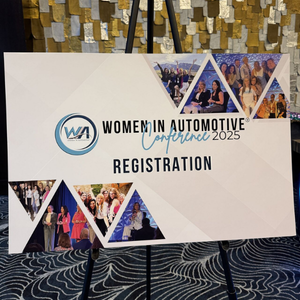
The 2026 Women In Automotive Annual Conference brings together women from across the automotive industry—from dealerships and OEMs to technology companies and beyond—for the conversations, connections, and community that fuel real change. This is where automotive careers for women are built, accelerated, and transformed. Registration and conference details are available at WomenInAutomotive.com. Come ready to laugh a little, lead with more intention, and think differently about the legacy you’re building every single day.