
Curiosity as Currency
How Conversations Shape Careers in Automotive
You're sitting in a virtual meeting, and someone asks you about a data point you don't recognize. You nod. You say something like, "Yes, I'm aware of that — please continue." And inside, your stomach drops, because you have no idea what they're talking about. You spend the rest of the meeting hoping no one circles back to you on it. You leave having learned nothing, but you performed beautifully. And that performance is exactly the problem.
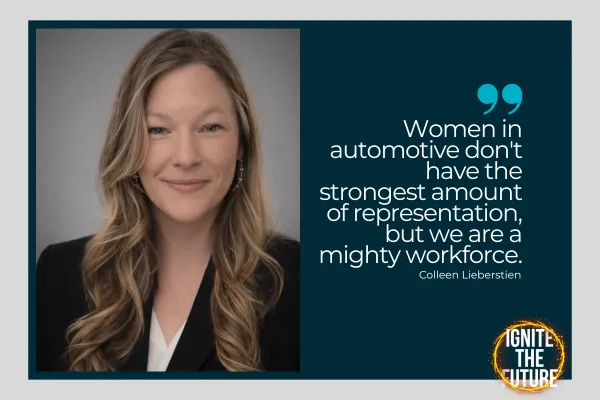
Colleen Lieberstein knows that moment. She's lived it, she's watched other women live it, and at the 2026 Women In Automotive Annual Conference, she's going to challenge every woman in the room to stop letting it hold them back. Her Breakout Session, "Curiosity as Currency: Using Conversation to Build Confidence and Capability," isn't a networking workshop. It's a communication strategy session built around a deceptively simple idea: the conversations you're willing to have, and the ones you're avoiding, are shaping how people perceive you, what opportunities reach you, and how far your career can go.
Colleen is the Event and Marketing Manager at StoneEagle, with 15 years in the automotive industry and a career path that proves her point about curiosity better than any framework could.
A Career Built on Saying Yes to the Unfamiliar
Colleen didn't start in automotive. She started in a high school English classroom, teaching teenagers to read books they didn't want to read; a job that, as it turns out, teaches you a lot about reading a room. When she stepped away from teaching to start a family and couldn't find a position when she returned, she pivoted into marketing. It wasn't the plan. It became the path.
"I loved that it was a problem I always had to try to solve and it was always evolving," Colleen said of marketing. She saw it through the lens of puzzle-solving: how do you reach an audience, intrigue them, make them engage? That reframe, from educator to strategist, set the trajectory for everything that followed.
Her next leap was into the startup world at Dealer Inspire, where she worked alongside founder Joe Chura. In a startup environment, titles mattered less than contribution, and
Colleen found herself sitting around an executive table where her voice was not just welcomed but expected. "Joe wouldn't have allowed me just to be a note taker," she recalled. "My voice was important." That experience, being valued for what she brought to the conversation, not just the title on her business card, shaped the executive presence she carries today.
From Dealer Inspire, Colleen moved into the Cars.com enterprise ecosystem, then to her current role at StoneEagle, where she's immersed in the F&I side of automotive; a space she openly describes as a learning curve. And she's energized by that, not embarrassed. "I'm about to be 44 years old this year," she said, "and I'm excited to learn and grow every step of the way." Every role prepared her for the next one. Every unfamiliar space became a source of strength. That's not accidental. It's the product of the very mindset she's bringing to the WIA stage.
The Water Cooler Conversation You Don't Realize You're Having
The insight at the center of Colleen's session came from a conversation with Alex Vetter, former CEO of Cars.com and a vocal advocate for Women In Automotive and serves on our Advisory Board. They were discussing the informal conversations that happen in the margins of the workday, the pre-meeting small talk, the hallway exchanges, the moments between the agenda items. And they noticed a pattern.

Think about the last time you were standing in a circle before a meeting started, or sitting in a virtual waiting room making conversation. What did you talk about? Now think about the conversation happening three feet away, or in the chat thread you weren't part of. Were they the same conversation? Vetter observed that when he stood at the proverbial water cooler with male colleagues, the dialogue often turned to investments, industry shifts, what Amazon was doing in auto, what was happening with Carvana, substantive business topics. With female colleagues, without any conscious bias, the same conversation often defaulted to family, kids' schedules, weekend plans. Personal, warm, and real. But narrow.
Colleen is careful not to diminish those personal conversations. "Our comfort zone tends to be our family because we're so passionate about them, as we should be," she said. But she wants women to recognize what happens when those are the only conversations they're having. People tend to remember the first few things you repeatedly present about yourself. If you only talk about your kids, your colleagues will associate you with your role as a parent, not your strategic thinking, your curiosity about the industry, or your ambitions.
This isn't about suppressing who you are. It's about expanding how people see you. And it starts with one conversation where you choose to bring something different to the table.
The Courage to Say "I Don't Know"
Here's where Colleen's message gets personal and uncomfortable; in the best way. She believes one of the biggest barriers to women's professional growth is the deeply ingrained pressure to never reveal a gap in knowledge. From your first job interview, you're coached to reframe weaknesses as strengths. The culture of "fake it till you make it" teaches you to perform certainty even when you're uncertain. And over time, that performance becomes a prison.
"We as women have a hard time coming to a conversation and saying we don't know something," Colleen said. And she has the data to back it up, research she'll share in her session that shows women are significantly more likely than their male counterparts to avoid admitting uncertainty in professional settings. Meanwhile, the man across the table has no hesitation asking someone to explain a data point he missed.

But Colleen isn't asking you to walk into your next meeting and announce your shortcomings. Her marketing background shows up here: it's all in the positioning. There's a difference between "I don't understand this" and "I've just started learning about this. I'd love to hear your perspective." The first feels like a deficit. The second signals curiosity, engagement, and the kind of intellectual honesty that makes people want to collaborate with you.
She witnessed this firsthand at StoneEagle, when a senior female sales leader opened a meeting by saying she'd been in board meetings all week and hadn't had time to pre-read the materials. She didn't minimize it or pretend. She simply said, "I'm coming at this with a blind spot. Let's start from step one." It was one of the most impactful moments Colleen has experienced in a professional setting, not despite the vulnerability, but because of it.
"Nine times out of ten, you can tell when someone hasn't done the reading," Colleen said, drawing on her years as an English teacher. "When you hide that or try to be inauthentic with it, that's when people start questioning whether you're genuine." Authenticity, even when it exposes a gap, builds more trust than performance ever could.
The Conversations You're Avoiding Are Costing You
Colleen sees a version of this avoidance playing out across the industry right now around technology specifically, AI. Many professionals are using AI tools but reluctant to talk about it openly, afraid it diminishes their expertise or signals that they can't do the work themselves.
"If you are using the fear of what technology and AI is bringing to hold you back, then you're again being inauthentic," she said. The professionals who openly engage with change position themselves ahead of the curve. The ones who avoid those conversations quietly fall behind, missing the chance to learn from peers navigating the same shifts.
This extends beyond technology. Any topic you're avoiding because you're afraid of looking uninformed is a topic where you're choosing stagnation over growth. And in an industry that moves as fast as automotive, that choice compounds quickly.
Showing Up in the Remote Workplace
Here's what no one told you when your office went remote: the disappearance of in-person interaction didn't lower the stakes of how you show up. It raised them. You now have fewer moments to make an impression, fewer chances for organic connection, and more ways to accidentally signal that you're checked out. Every virtual meeting is a conversation that's either building your presence or eroding it, and Colleen sees too many professionals opting out without realizing what it's costing them.
The first and most visible way professionals isolate themselves, in Colleen's experience, is by turning their cameras off. She understands the impulse and isn't interested in shaming anyone. But she's direct about what it communicates. When you join a meeting and say, "I didn't have a chance to do my makeup, so I'm leaving my camera off," what the other person hears is that this meeting wasn't worth the effort of showing up fully.

The second pattern she sees constantly is the failure to silence notifications during virtual meetings. "You wouldn't have somebody burst through the door of a meeting room to tell you a trivial update," Colleen pointed out. But we accept exactly that level of interruption in virtual settings; Slack messages popping up mid-conversation, eyes drifting to the corner of the screen, followed by the deflating request: "I'm sorry, I missed what you said. Can you repeat that?"
These aren't small things. They're signals about how much you value the people and the conversations in front of you and in a remote world, those signals carry enormous weight.
When the Room You Need Is Outside Your Comfort Zone
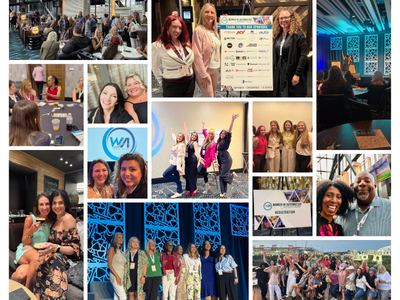
Colleen's own experience at last year's Women In Automotive conference illustrates why the mindset she's teaching matters so much. She walked into that room with admiration for the women around her and with the quiet voice in her head asking whether she belonged among them. She questioned her own credentials. She hesitated before approaching women she looked up to, thinking they wouldn't want to hear from her.
Then she challenged herself to push past that. She connected with three women who became ongoing mentors, new relationships that have continued well beyond the conference. One session particularly resonated: a call to retire the phrase "imposter syndrome" entirely. "It truly shifted my thought process," Colleen said. "Every person in that room deserves to be in that room." The woman she had been too intimidated to approach? She didn't just welcome the conversation, she became one of those three mentors. The barrier Colleen had built in her own mind was never real. And that realization changed how she shows up in every room since.
That shift from "I don't belong here" to "I have something to contribute here" is exactly the shift Colleen wants to create for every woman in her session. Confidence isn't something you build in isolation and then bring to the room. It's built through the act of engaging, asking, and contributing, even when, especially when, it feels uncomfortable.
A Session for Every Woman Who's Ever Held Back
Colleen designed her session to be immediately practical. Attendees will walk away with frameworks for identifying their own knowledge gaps, strategies for positioning curiosity as a strength rather than a weakness, and tools for building executive presence through the conversations they're already having. Whether you're in a dealership, on a corporate team, or managing from a home office, the principles apply.
"Women in automotive don't have the strongest amount of representation," Colleen said, "but we are a mighty workforce." Her session is an invitation to show up as that mighty workforce — not by pretending to know everything, but by being courageous enough to keep learning out loud.
Join Colleen Lieberstein at the 2026 Women In Automotive Annual Conference, July 17–20 in Austin, TX, for "Curiosity as Currency: Using Conversation to Build Confidence and Capability." Register today and take the next step in a career built on the conversations that matter most.