
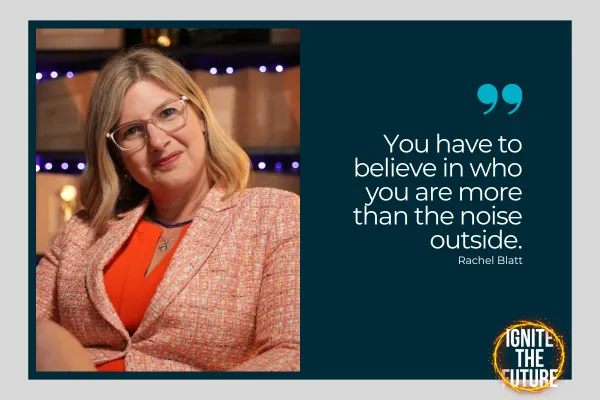
Busting Through the Blocks
Rachel Blatt on Confidence, Self-Advocacy, and Leadership Growth
You know what to do. You know you're capable. You know you deserve more. And yet, the moment you sit down to negotiate, to set a boundary, to raise your rates, to say what you actually think in a room full of people who are used to you staying quiet, something happens. Your chest tightens. Your voice softens. The rational part of your brain starts drafting an exit strategy disguised as logic: maybe later. I'm not ready. I need more experience. I don't want to seem difficult.
Rachel Blatt calls that the excuse train. And she wants every woman in automotive to stop boarding it.
Rachel is the CEO of Royalty Logistics, a transportation company that serves dealerships, OEMs, fleet companies, and the rental business across the automotive industry. She didn't plan to be here. After eight years in tech, watching a company her father helped build from the ground up grow into a billion-dollar enterprise and eventually sell to venture capital, Rachel found herself out of a job with three options: go back to tech where she was bored, sell mortgages in a space that didn't fit her, or go work for the largest auto hauling company in the country. She chose the gritty option. She was one of three women among 100 male sales reps. She thrived.
Two companies later, after being told by her third employer that she made too much money, even as she was generating significant revenue for them, Rachel made the decision that defined everything since: the only company that was ever going to do it right was her own. Her Breakout Session at the 2026 Women In Automotive Annual Conference, July 17-20 in Austin, TX, "Bust Through the Blocks," is built from everything she's learned in the process of building, failing, rebuilding, and refusing to stop.
Your Nervous System Reacts Before Your Brain Does
Rachel's framework starts where most leadership conversations don't: in the body. The moment a woman tries to expand, to ask for more money, to set a boundary, to take up space she's earned, her nervous system often reacts before her brain has a chance to process the logic.

"The second you try to take up space, your nervous system freaks out," Rachel said. That reaction isn't weakness. It's conditioning. Women are taught from childhood to prioritize comfort over expansion. Be agreeable. Be likable. Don't intimidate people. Don't make others uncomfortable. Those instructions didn't stay in childhood. They followed women into boardrooms, negotiations, and leadership decisions where the stakes are real and the cost of shrinking is measured in dollars, opportunity, and years.
The blocks Rachel is talking about aren't just mental. They're emotional and physiological. And many women mistake that internal discomfort for a signal to stop, when it's actually a signal that they're about to grow. If you've ever been in a meeting where you knew the answer, felt your heart rate spike, and stayed quiet anyway, that wasn't a lack of knowledge. That was your nervous system protecting you from something your conditioning told you was dangerous: being visible.
The Excuse Train Is Always Running
Rachel doesn't sugarcoat it. Fear is creative. It doesn't announce itself as fear. It shows up as a perfectly reasonable argument for inaction. "I want to do this, but." "I should, but." "I'm not ready yet." "Maybe next quarter." Every excuse feels rational in the moment, and that's exactly what makes it dangerous.
"All aboard the excuse train," Rachel said. The women most likely to be riding it aren't the ones who lack ambition. They're the ones who have ambition and have been conditioned to doubt whether acting on it is safe. They intellectually know their value. They emotionally struggle to advocate for it. And the gap between knowing and doing is where careers quietly stall.
Rachel has lived every block she teaches about. While preparing for this session, she experienced a wave of them simultaneously: financial pressure, a child hospitalized, a parent hospitalized, everything pulling her away from where she was trying to go. She's not teaching from theory. She's teaching from the middle of it.
The Leader Needs to Eat First
One of Rachel's most provocative reframes flips a popular leadership principle on its head. The business world loves the idea that the leader eats last. Rachel's experience as a woman, a mother, and a CEO has taught her the opposite.

"Not when you're a woman," she said. "The leader needs to eat first because we're going to be depleted." Women are programmed to take care of everyone else first. The children, the partner, the team, the clients, the home. By the time they get to themselves, there's nothing left. And a depleted leader can't show up for anyone, no matter how much she wants to.
Rachel is direct about the cost of learning this lesson the hard way. She's poured into people who weren't there when she needed help. She's given to the point of emptying herself, then wondered why she couldn't perform at the level she expected. You've felt it too. You gave your best energy to everyone else's priorities today. You sat down at 9 p.m. wondering why you're exhausted, why you snapped at your kids, why the thing you wanted to work on never happened. That's not a time management problem. That's a depletion problem. And no productivity hack is going to solve it. You have to eat first.
Stop Apologizing for Existing
Rachel sees a pattern in how women communicate that goes deeper than professional habits. It's embedded in the language itself. The unnecessary apologies. The over-explaining. The softening of every statement until the original meaning is barely recognizable. The instinct to make a direct opinion sound like a question so it feels less threatening to the room.
"Stop apologizing for existing," Rachel said. That's not a motivational soundbite for her. It's a daily practice. Confident leadership often begins by removing the language that signals uncertainty, not because the uncertainty isn't real, but because broadcasting it gives other people permission to underestimate you.
And when they do underestimate you? Rachel has a perspective on that too: "If anybody's trying to bring you down, it means they're already below you." She's been called too much, too direct, too aggressive. At some point, she stopped internalizing it. Not because the words stopped coming, but because she decided that believing in who she is matters more than the noise.
Leadership Doesn't Have to Look Corporate Perfect
Rachel describes her leadership style as quirky, and she's done apologizing for it. She shows up as herself. She doesn't wear the black suit. She doesn't perform composure when she's feeling something real. She's transparent about her struggles, vulnerable about her journey, and direct in a way that makes some people uncomfortable and earns deep loyalty from others.
"No longer do I want to try to become somebody else," she said. "I want to be who I am."
That vulnerability has cost her at times. People have used her openness to attack her when she was down. She acknowledges it without flinching: "I'm an easy target, but a formidable enemy." The attacks didn't stop her from being transparent. They taught her that authenticity requires resilience, not protection. The traits women are often told to tone down, the directness, the intensity, the refusal to perform someone else's version of professional, are frequently the exact traits that make them unforgettable leaders.
The Slingshot
Rachel closes with an image that captures her entire philosophy: the slingshot. The harder you're pulled back, the further you're going to fly forward. Every block, every setback, every moment where it felt like everything was working against her was creating the tension that would eventually launch her into the next phase.
"However far you get pulled back is however you're going to shoot forward," she said. She's been pulled back extremely hard. And she's ready.
If you're in a season right now where everything feels like resistance, where the blocks are stacking up and the tension won't let go, consider the possibility that what you're feeling isn't failure. It's the drawback before the launch. The question is whether you'll let go of the fear long enough to fly.
A Session for Every Woman Who Feels Stuck Despite Being Capable
Rachel designed her session for the woman who knows she's capable but can't figure out why she's not moving. The one who has the ambition, the talent, the work ethic, and still feels stuck. The one who is tired of the excuse train and ready to get off.

Attendees will leave with practical tools for recognizing and dismantling emotional blocks, negotiation strategies, and techniques Rachel has used to manifest results in her own business and life, including practices she's invested significant time and resources to learn. This is not theory. This is what Rachel does every day to stay in motion when everything around her is trying to pull her back. And for attendees who want to protect the energy Rachel's session unlocks, Dara Koenig's burnout session pairs naturally as the next step: bust through the blocks, then learn how not to deplete yourself on the other side.
If you're reading this and recognizing yourself in the excuse train, in the apologizing, in the tightness that shows up every time you try to take up space, Rachel wants you to know something: she's been on that train too. She's been pulled back harder than most people will ever know. And she's still here, still building, still showing up. The blocks are real. The conditioning is real. The fear is real. And none of it has to be the end of the story.
Join Rachel Blatt at the 2026 Women In Automotive Annual Conference, July 17-20 in Austin, TX, for "Bust Through the Blocks." Register today, and stop letting the blocks win.