
Avoiding Burnout in Automotive
Dara Koenig on Boundaries, Pressure and Actual Sustainability
Burnout rarely announces itself. It doesn't arrive as a crisis you can point to or a moment you can name. It builds slowly, quietly, professionally, often while you're still performing at the highest level. The woman most likely to burn out isn't the one who has given up. She's the one who is still giving everything: first in, last out, volunteering for weekends, carrying more than anyone realizes, and measuring her value by how much of herself she can pour into the work before there's nothing left.
If that sounds familiar, if you just read that paragraph and thought "that's just how this industry works," Dara Koenig wants you to sit with that reaction. Because normalizing depletion is exactly how burnout wins. The moment exhaustion stops feeling alarming and starts feeling expected is the moment you've crossed a line most people don't come back from without help.
Dara is an Executive Coach with The Koenig Group, a former automotive marketing and training professional who spent over a decade building websites, running campaigns, and training dealerships across the country as a national trainer for AutoAlert. She didn't study burnout from a textbook. She watched it happen, up close, across years of working in an industry that treats exhaustion as a badge of honor. Her Breakout Session at the 2026 Women In Automotive Annual Conference, July 17-20 in Austin, TX, "Avoiding Burnout: Protecting Your Energy in Demanding Leadership Roles," is built on a single reframe that changes everything: burnout is not a personal failure. It is a symptom.
The Industry That Knows How to Work Itself Into the Ground

Dara entered automotive the way most people do: by accident. She met someone who needed an assistant, she needed a job, and a career in dealership marketing took root. She'd been studying interior design, drawn to the psychology of creating environments that shape how people feel. Marketing, it turned out, used the same muscles: controlling the narrative, shaping perception, telling the right story. She built a career in website strategy and dealer marketing that spanned agencies, independent consulting, and dealer groups before moving into national training.
Through all of it, she watched the same pattern repeat. Talented, ambitious, dedicated professionals, especially women, grinding themselves into the ground because the culture rewarded it. "One thing we know how to do well in automotive is work ourselves into the ground," Dara said. Bell-to-bell schedules. Seven-day weeks. The expectation that if you want to be taken seriously, you sacrifice everything else first.
And it's not limited to sales floors. That same pressure follows women into vendor roles, corporate positions, and leadership seats across the industry. The titles change. The pattern doesn't.
Why Women Are Especially Vulnerable
Dara is direct about why burnout hits women in automotive harder and more often than the industry acknowledges. It's not because women are weaker. It's because many women are carrying an invisible weight on top of the work itself: the pressure to constantly prove they belong.
"We feel like we need to externally prove it and have it validated," Dara said. Women will outwork their male counterparts not because the job demands it, but because somewhere along the way they internalized the belief that their presence alone isn't enough. They need to be more productive, more available, more willing to sacrifice in order to earn the credibility that others receive by default.
That pattern creates a specific kind of burnout. It's not the burnout of someone who hates their job. It's the burnout of someone who cares too much, gives too much, and has tied her identity so tightly to her output that she no longer knows who she is without it.
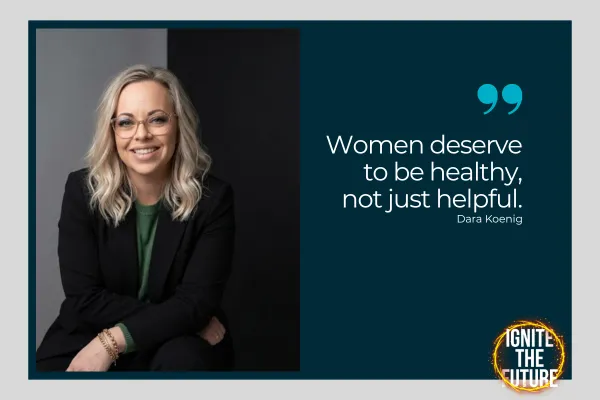
"Women deserve to be healthy, not just helpful," Dara said. That line is the emotional center of her workshop, and it's the truth that many women in this industry have never heard anyone say out loud.
Blurry Boundaries Are a Breeding Ground

If there's a single operational cause Dara returns to more than any other, it's boundaries, or the absence of them. "Blurry boundaries are a breeding ground for burnout," she said. The inability to say no. The guilt that follows when you do. The pattern of overcommitting because being needed feels like being valued. The lack of recovery time that turns chronic stress into a permanent state.
Strong boundaries aren't selfish. They're protective. They're what allow a career to be sustainable rather than a slow-motion collapse disguised as dedication. And for many women, learning to set them is the single most important skill they've never been given permission to develop.
When Purpose Turns Into Survival
Dara's burnout framework is built around three contributors: purpose, patterns, and pressure. What makes it distinctive is where she draws the line of personal responsibility. Pressure is the only contributor that's primarily external. Purpose and patterns are internal. Two of the three reasons people burn out, Dara believes, they do to themselves.
That's not a blame statement. It's an empowerment one. If the causes are largely internal, so are the solutions.
The progression she teaches moves through five stages, from a healthy, sustainable baseline through escalating stress, chronic depletion, burnout, and ultimately habitual burnout, where exhaustion has become so normalized that the person no longer recognizes what healthy looks like. By stage three, Dara's research shows, most people have lost connection to their purpose entirely. What started as passion has been replaced by survival patterns. They're still showing up. They're still performing. But the reason they started has been buried under the weight of just getting through the day.
"We work ourselves out of our purpose into just becoming habits," Dara said. And the saddest part is that many women in this stage don't even recognize themselves anymore. They've become someone they wouldn't have chosen to be, and that disconnect only accelerates the cycle.
You may be reading this and wondering where you fall. Here's what stage three and four often look like in practice: you signed back into email from your couch last night. You can't remember the last weekend that didn't include work. You've started dreading Monday before Sunday is even over. You told someone you were "fine" today and didn't believe it when you said it. None of those are dramatic. All of them are data. And the fact that they feel normal is itself the clearest sign that they shouldn't be.
Burnout Never Stays at Work

Dara is unflinching about a truth that most burnout conversations tiptoe around. "You can't have a thriving home life and a burned out professional life," she said. "It just doesn't happen. They correlate."
The cynicism, the emotional exhaustion, the short fuse, the inability to be present: these don't clock out when you leave the building. They follow you home. They affect your relationships, your parenting, your sense of self. And at stage five, habitual burnout, the damage extends beyond the individual. A chronically burned-out employee doesn't just suffer in isolation. She pollutes the environment around her, both at work and at home, often without realizing it.
The Leadership Responsibility Nobody Can Avoid
Dara is careful not to position burnout as purely a personal problem. The environment matters. "The environment alone does not create burnout," she said. "It either fuels it or it stops it."
That distinction places a direct responsibility on leadership. Toxic cultures accelerate burnout. Healthy cultures interrupt it. And leaders who ignore the signs, or worse, who reward the very behaviors that lead to burnout (the late nights, the weekend work, the always-on availability), are building a pipeline of depletion whether they realize it or not.
"The ones who are burnt out now were probably the ones working late nights three months ago," Dara said. The highest performers are often the most at risk, because their burnout disguises itself as dedication until the crash happens. Leaders who learn to recognize the early signs can intervene before losing the people they can least afford to lose.
As Dr. Martha Rader observed during their conversation, the pressures of modern work culture, including AI adoption, doing more with less, and constant connectivity, aren't going away. "I can't imagine this getting better anytime soon," Martha said. Which is precisely why this conversation can't wait.
A Workshop That Meets You Where You Are
Dara designed her session to be interactive, practical, and immediately applicable. Attendees will be invited to take a mini-assessment during the session to identify exactly where they fall on the five-stage burnout scale. It's not a general wellness quiz. It's a specific, honest mirror designed to show you what you've been normalizing. From there, attendees will begin building a personalized prevention plan they can take home and continue developing.
"If you don't know, then you can't change anything," Dara said. The assessment is the starting point. The plan is the path forward. And the only requirement is honesty. "You can't fix something that you're still hiding from yourself."
For attendees looking to build on the workshop's foundation, Stephanie Dean's session on reigniting purpose when success stops feeling like success and Cassie Cepeda's session on reclaiming your identity from the narratives others have written for you both pair naturally. One session to recognize the burnout, one to reconnect with your purpose, and one to reclaim who you are underneath it all.
When asked what she hopes attendees feel during and after the workshop, Dara's answer was immediate: "First and foremost, I want them to feel seen." Because so many women are carrying chronic symptoms in silence, running on autopilot, performing well enough that no one thinks to ask how they're actually doing. For those women, sometimes healing begins the moment someone says: this isn't just you, and you don't have to stay here.

Burnout is not who you are. It's information about where you've been and how long you've been running without stopping. The goal is not to become less ambitious. It is to become healthy enough to sustain the life and leadership you are building.
If you read this article and something in it felt too familiar, that's not a coincidence. That's the recognition Dara's entire workshop is built around. You don't have to stay where you are. You don't have to keep performing your way through exhaustion. And you don't have to figure it out alone.
Join Dara Koenig at the 2026 Women In Automotive Annual Conference, July 17-20 in Austin, TX, for "Avoiding Burnout: Protecting Your Energy in Demanding Leadership Roles." Register today. You've been seen. Now let someone show you the way back.