
Reclaiming Your Voice in Automotive Leadership
Cassie Cepeda on Self-Doubt, Identity, and Confidence
Here's a question most women have never been asked directly: who is writing your story right now?
Not the polished version. The one on your LinkedIn profile, the one you rehearse at networking events. The real one. The internal narrative that runs underneath everything you do professionally. The voice that tells you whether you belong in the room, whether your idea is worth saying out loud, whether you've earned the right to take up space. If you're honest about where that voice came from, there's a good chance it wasn't you who wrote it.
Cassie Cepeda has spent over 20 years in the automotive industry, 12 on the dealer side, eight on the vendor side, and she'll tell you that the hardest challenges she's faced had nothing to do with performance metrics or career pivots. They had to do with the stories she was carrying about herself. Stories written by other people's opinions, other people's labels, other people's expectations. At the 2026 Women In Automotive Annual Conference, July 17–20 in Austin, TX, Cassie is bringing that reckoning to the stage. Her Breakout Session, "Don't Hand Them the Pen: Reclaiming Your Voice in a World That Tries to Define You," is an invitation for every woman in automotive to examine who has been holding the pen on her identity and what it would mean to finally take it back.
Cassie is the Manager of Showroom Performance at AutoFi, and her session is not surface-level empowerment. It's identity work. Reflective, challenging, and built from lived experience.
The Scars You Can't See Are the Ones That Shape You
Cassie anchors her message in a psychological study that stopped her in her tracks. Researchers placed fake scars on participants' faces and told them they'd be entering public spaces to see how people reacted to visible disfigurement. What the participants didn't know is that before they left the room, the researchers secretly removed the scars.

Even though the scars were gone, every participant still behaved as if they were there. They were more self-conscious, more hesitant, more withdrawn. They were certain people were staring, judging, treating them differently. Because of something that no longer existed.
"I feel like many of us carry these invisible scars every day," Cassie said. And she's speaking from experience. At various points in her career, people questioned her worth, her intelligence, her leadership, her abilities. Those moments were temporary. The imprint wasn't. Over time, it became the narrative. She stopped needing other people to limit her because she began limiting herself. Shrinking in rooms where she deserved to stand tall, hesitating before speaking, and convincing herself she needed permission to do things no one was actually stopping her from doing.
The Gremlin in Your Head
Cassie has a name for the internal voice that keeps the old narrative alive: the Gremlin. She explored the concept in her LinkedIn article "Don't Listen to the Gremlin," and it resonated far beyond her expectations. A moment at NADA stands out: a senior male colleague pulled her aside to say he'd read it and recognized himself in every word. Self-doubt doesn't discriminate by title or gender. But the way women experience it, and the systems that reinforce it, are particular.
The Gremlin is the voice that tells you your idea isn't ready yet. That you need one more credential before you apply. That if you attend an industry conference, people will think you're looking for another job. Cassie lived inside those patterns for years, waiting for external validation that was never going to arrive. Not because she hadn't earned it, but because she was looking for it in the wrong place.
"I kept expecting the companies that I represented to do it for me," she said. "Because if they promoted me, then I deserve to be promoted. And that's not it at all. It's just learning who you are." When she finally gave herself permission to attend WIA, to go to NADA on her own dime, to put her voice into the industry, nobody pushed back. Her team applauded her. The barriers she'd been navigating around for years had been constructed entirely by the Gremlin.
The Pressure to Be Palatable
Cassie's message cuts deeper than personal confidence. It's about a systemic dynamic that women in automotive, and in most male-dominated industries, navigate every day: the pressure to self-edit in order to be accepted.
You've felt it. The instinct to soften an opinion before delivering it. The calculation of whether speaking directly will earn you a label. The awareness that the same resume, the same leadership style, the same conviction reads as "confident" on a man and "arrogant" or "difficult" on a woman. Cassie references research from Valerie Young's The Secret Thoughts of Successful Women showing exactly that: identical resumes evaluated differently depending on whether the name at the top was male or female. The man gets praised for his ambition. The woman gets flagged for being too aggressive.

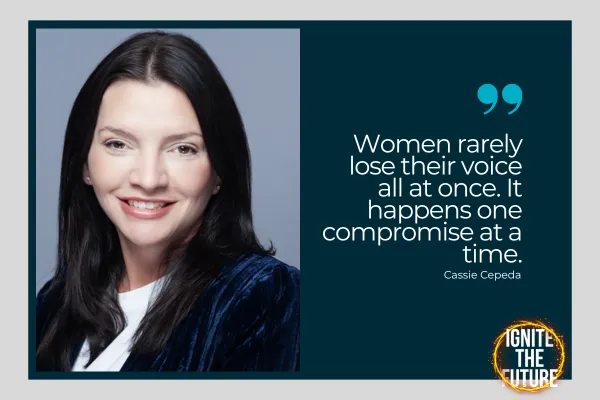
"We were taught to be quiet, cross your legs, sit up straight, smile," Cassie said. Those instructions didn't stay in childhood. They followed women into conference rooms, into performance reviews, into the internal narratives that govern how they show up. And the cost isn't just discomfort. It's a slow disappearance. Women rarely lose their voice all at
once. It happens one compromise at a time, one silenced opinion at a time, until the Gremlin doesn't even have to work hard anymore. The self-editing has become automatic. Think about the first meeting where you held back. The first time you let someone else say the thing you were already thinking. The first time you calculated the cost of speaking up and decided it wasn't worth the label. You can probably trace the line from that moment to who you are in meetings today. Cassie can trace hers, and her session is built to help you see the pattern clearly enough to break it.
Why Medusa Matters
Cassie is weaving a metaphor through her session that she's deliberately keeping close, and it deserves the intrigue. The story of Medusa, she says, is almost always told as a cautionary tale about a monster. Rarely is it told as the story of a woman who was punished, transformed, and then reduced to a single image that erased everything she was before.
"Everybody looks at Medusa as this evil, snakes in the hair, angry all the time," Cassie said. "But if you really look back at how she became that way, you can understand." She's saving the full arc for Austin. It's the kind of reframe that needs to be felt, not summarized. What she will say now is that the metaphor resonates because many women know exactly what it feels like to be misunderstood, mislabeled, and reduced to a version of themselves that someone else created.
The Advice You'd Give Your Younger Self, Given to Your Present Self
One of Cassie's most disarming provocations flips a familiar question on its head. Everyone has an answer to "what would you tell your younger self?" Believe in yourself, take more chances, stop worrying what people think. The responses come immediately because the distance makes them safe.

But Cassie pushes further: why can't you tell your present self the same thing?
"It's so easy to offer compassion and encouragement to our younger selves, that person that doesn't even exist anymore," she said. "But I'm willing to bet the advice we wish we could give our younger selves is the advice we still need to hear today." That reframe is the emotional core of her session: the recognition that the wisdom you'd offer a younger version of yourself is the same wisdom the present version is starving for and refusing to receive.
Finding Your Hype People
When asked for one practical step women can take today, Cassie's answer is immediate: find your hype people. Not sycophants. Not people who tell you what you want to hear. People who see you clearly and remind you who you are when the Gremlin starts talking.
"We create that Gremlin by the external world of what people tell us," she said. The antidote is external too, but intentionally chosen. Cassie already had a small circle of those people before she ever walked into a WIA conference. One woman in particular has a habit of showing up at Cassie's front door and dragging her out of the house when she's spent too long hiding in her comfort zone. She's the one who encouraged Cassie to attend her first Women In Automotive conference, stood beside her the entire time, and was her biggest cheerleader long before Cassie believed she belonged in the room.
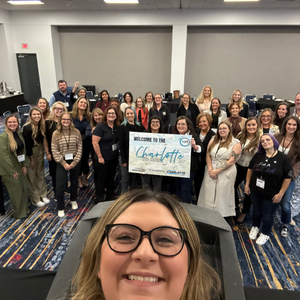
What WIA gave her wasn't the circle. It was a bigger table. It introduced her to more women who believed in lifting each other up, pulling up extra chairs, and making sure there was room for everyone. "I remember having a conversation with someone and getting literally teary-eyed," Cassie said, "because I have never had that moment of being able to be that vulnerable." Her circle didn't start at WIA, but it grew there in ways she never expected.
A Session for Every Woman Who's Been Living in Someone Else's Story
Cassie designed her session for the woman who has spent years adapting herself to fit environments that were never built with her in mind, and is ready to stop. Attendees will leave with practical tools for recognizing the Gremlin, separating their identity from outside perception, and reclaiming their narrative without apology.
This is not a "just believe in yourself" session. It's a reckoning with the stories women have been handed and the ones they've unknowingly accepted. It's identity work: deep, honest, and built for a room full of women who are ready to pick up the pen. And for attendees looking to carry that momentum across the full conference experience, Cassie's session pairs naturally with Stephanie Dean's on reigniting purpose when success stops feeling like success, and Dara Koenig's on protecting yourself from the burnout that comes from years of performing for everyone else's expectations.
Cassie's own practice for staying grounded is disarmingly simple: coffee on the front porch before the day starts, sun on her face, a moment of stillness before the noise begins. That intentional space between who the world says you are and who you actually are. That's where reclamation begins. Not in a grand gesture. In a quiet morning where you remember your own voice before anyone else's gets a chance to speak over it.
Join Cassie Cepeda at the 2026 Women In Automotive Annual Conference, July 17–20 in Austin, TX, for "Don't Hand Them the Pen: Reclaiming Your Voice in a World That Tries to Define You." Register today, and start writing the story only you can tell.