From Dealership Cashier to CFO: Dina Vogt’s Automotive Career
Maybe It Wasn’t Him Who Changed. Maybe It Was Me.
Early in her career, the outside accountants terrified Dina Vogt. Every year the CPAs arrived to do the dealership’s auditing, and every year she felt outmatched. “They were so intimidating to me,” she says. “I felt like they were all smarter than me. They all went to school. They were all CPAs.”
One of them, in particular, she practically idolized. He seemed to know everything. His answers were always definitive. “Nothing was ever like, well, maybe you should. It was always you must.”
Years later, Dina crossed paths with him again. By then she was CFO of Ray & Raymond Automotive Group, and he completed a project for the company. When he turned in his analysis, she read it and had a thought she never expected.
“Well, that’s it. Like I could have done that.”
She had been braced for something brilliant. What she found instead was a realization about herself. “Maybe it’s not him that changed so much,” she says. “Maybe it’s me.”
How does someone go from wondering whether she belongs in the room to recognizing the value of what she knows? For Dina, that confidence wasn’t built in a classroom. It started behind the cashier’s desk of a dealership when she was 18.
A Part-Time Dealership Job That Wasn’t Supposed to Become a Career
Dina graduated high school early and didn’t feel ready to go away to college. So she enrolled in community college, took classes in the morning, and started working a part-time cashier job at a dealership close to home, from noon to nine.

At first, it felt hard. Then one day, things started to click.
What hooked her wasn’t the cars. It was that there was always something new to figure out. Even a full day of license and title work meant every deal brought a slightly different situation.
People noticed she was capable, and that feedback mattered. “Maybe I’m good at this,” she remembers thinking.
Her schedule gradually tilted toward the dealership, and she told herself she’d get back to school. She never did, and she still wishes she had. But she found another kind of education in the dealership, one that would shape everything that came next.
The Office Manager Who “Dumped Everything” on Her
As the cashier, Dina quickly became what she calls “the catch everything girl.” If something needed doing in the office, it landed on her desk.
Eventually she worked under an office manager named Cindy, and Cindy drove her crazy. To Dina, it looked like Cindy handed her everything and then coasted while Dina was buried in work. She would go home and complain to her parents about it.
Today, Dina sees it very differently.
“What I didn’t realize at the time is how well she set me up,” she says. Cindy taught her to be organized and, one assignment at a time, exposed her to nearly every part of the office. Dina isn’t even sure Cindy meant it as development. It didn’t matter. Dina learned because she was doing the work.
Then Cindy quit.
Suddenly, all the things Dina had complained about learning looked like evidence that she might be ready for something bigger. Her parents saw it before she did.
“You Have to Ask for That Job.”
When Dina came home and told her parents Cindy had quit, their answer was immediate: “Well, you have to ask for that job.”

Dina thought they were crazy. She had never been an office manager. She was 25. She had been at the dealership for seven years, but she had started as the teenage cashier and was still the youngest person in the office. “They look at you like you’re still the college kid that was the cashier,” she says.
She was scared to death. When asked what frightened her most, her answer wasn’t simply rejection. “I think maybe I was afraid of looking like a fool, like thinking that I knew more than I did.”
She didn’t know everything. There were things about monthly taxes and payroll she’d never handled. But she knew how she would find the answers. Cindy had been meticulous and kept photocopies of everything. There was an office manager at another store she could call. And she knew the dealership, its people, and its processes.
Underneath the fear was another realization. If she didn’t ask now, they might hire someone who stayed 20 years, and she would have to leave to get her chance.
So she marched in and asked.
The owner hesitated. How would she handle the things Cindy hadn’t taught her? Dina made her case and gave him a promise: “I’ll figure it out. I promise, I’ll figure it out.”
He said yes.
“I Better Act the Part Before I Even Really Have It.”
Getting the title was only the first negotiation.
When they tried to leave her at the same desk, Dina pushed back. She knew people needed to see her differently, and that wasn’t going to happen if nothing changed. She moved into the office.
When they questioned whether she really needed a demo, she pointed out that everyone who had held the job before her had one. So why wouldn’t she?
The woman who had been afraid of looking foolish for asking was now insisting that the role come with the standard already attached to it.
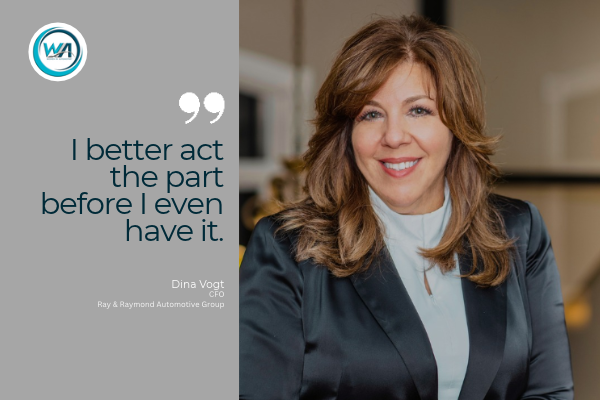
“Once he finally said yes, I thought I better hold my ground,” she says. “I better act like it. I better act the part before I even really have it.”
There was some pushback. One man in the office made it clear he wasn’t thrilled about answering to her. But Dina has never been “a bossy kind of boss,” she says, and over time people realized she was the same person, doing the work, with different responsibilities.
Learning to See Beyond the Numbers
Dina kept doing what she had done from the beginning: paying attention to far more than what was on her own desk.
“The best thing you could do is just keep your eyes and ears open,” she says, “far beyond what’s just at your desk.”
Even now, as CFO, she’ll stand behind the sales tower just to watch the activity and the dynamics on the floor. She’ll go sit in the cashier’s office to see the business from that angle. She doesn’t want to spend all day buried in numbers, because the numbers “tell a story, but they don’t always tell the whole story.”

Behind every figure is a person, a situation, or a reason something might be off. Her financial expertise wasn’t built in isolation. She understands the cashier’s desk because she sat there. She understands the office because she did nearly every job in it. She watches sales. She understands operations. And she brings the owners something rare in a business full of opinions: “I have the luxury of having black and white behind my job.”
The CFO she became was built from the ground up.
When Competence Finally Felt Like Confidence
The CPAs who once intimidated Dina didn’t stop being smart. Something else changed.
Her.
Over the years, she noticed that they might know more about filing a tax return, but “they don’t know this particular store or this particular business any better than I do.” As she grew more confident in her analysis, people started listening.
That’s what made the moment with the accountant she once idolized so striking. He hadn’t lost his expertise. She had built hers, through decades of being in it all day, every day.
At 25, Dina had to convince herself she knew enough to try. Years later, she no longer needed someone else’s credentials to validate what experience had taught her.
More Than One Door Into a Career in Automotive
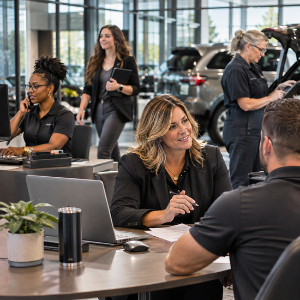
Dina wants women to understand how many opportunities exist inside a dealership. Too often, she says, women get pigeonholed into the office, the cashier’s window, or the BDC.
In her group, that isn’t the case. Their best-performing service manager is a woman. They have women working as technicians, service advisors, salespeople, porters, and lot attendants, and running the BDC. “There’s nothing you can’t do here,” she says. “Nothing you can’t do.”
Her daughter made the point for her. Home from college one summer, she saw a young woman working as a porter at the dealership.
“Well, Mom, why can’t I do that?”
“Well, there’s no reason why you can’t,” Dina told her. Her daughter, who liked being on her feet and running around, spent the summer as a porter.
Dina also wants women without a college degree to know they don’t have to feel held back in this industry. She would never discourage anyone from getting one, but there’s more than one way to build expertise, as long as you’re willing to work. “It’s not for the faint of heart,” she says. “If you’re looking to coast, this is not for you.”
An Industry That Keeps Changing and Somehow Stays the Same
Dina has watched automotive weather 2008, COVID, and now the arrival of AI. But she believes something fundamental remains: dealerships are part of their communities, in
every parade, every community event, and the local theaters. “I don’t worry about us being around,” she says.
At 18, Dina thought she had found a convenient part-time job close to home. She couldn’t have known she was stepping into the place where she would learn to solve problems, lead people, understand a business from the inside out, and eventually trust her own expertise.
Maybe that’s what she understands now that the 25-year-old asking for Cindy’s job couldn’t yet see. You don’t always recognize yourself becoming the person who is ready for the next opportunity. Sometimes you only realize how far you’ve grown when the people you once thought knew everything start looking a lot more like peers.
If you’re still waiting to feel ready, Dina’s story is your reminder that readiness often arrives after you ask. Join the Women In Automotive community at womeninautomotive.com and connect with women who will help you figure out the rest.