
Why Automotive Sales Is A Relationship Business
An Unexpected Automotive Career Built on Community, Coaching, and Conviction
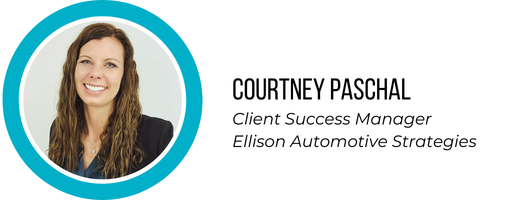
Courtney Paschal had her dream job lined up. Kitchen and bath designer. Interior design degree. A future in remodeling that she'd worked toward and wanted.
Then she was in a car accident. She went to a dealership to get a new vehicle, and someone asked if she wanted to work there.
"I know nothing about cars," she told them.
"That's fine. You've got this."
She called the owner of the design firm, explained the situation. "I want you to go work for that company," he said. "If it doesn't work out, call me."
Six months later, that design company filed for bankruptcy. Courtney would have lost her job anyway.
"It was all God who did it," she reflects now. Automotive wasn't the plan. But it became the provision.
Unexpected pivots are often where the most meaningful automotive careers begin
Learning the Business Through Blood, Sweat, and Tears
Courtney started as an assistant fleet manager at a Toyota dealership in 2013. She worked her way through BDC, Internet sales, leadership roles—learning through trial, failure, and persistence. The dealership life that most people never see from the outside.
"There was a lot of blood, sweat, and tears poured into it," she says. "Having to deal with a lot of stuff at the dealership, a lot of things that people don't talk about."
That frontline experience became the foundation for everything that followed. You cannot effectively coach what you've never lived. Leadership built on lived experience carries a credibility that cannot be manufactured. The struggles, the pressure, the reality of hitting goals while managing difficult customers and internal dynamics—Courtney lived all of it before she ever stepped into a training role.
She met her husband at the dealership. Built a career she never anticipated. And discovered that the creativity she'd developed studying interior design translated perfectly into automotive.
"If you're painting a room and it doesn't work, you repaint it, sand it down, try something different," she explains. "That's the same thing with being in the business. You try it, and if it doesn't work, try something else until it does."
Design thinking applied to dealership strategy: test, refine, improve. Creativity isn't a detour from automotive success—it's an asset.
Leading from Behind the Scenes
Today, Courtney serves as Client Success Manager at Ellison Automotive Strategies. In December 2023, she left the dealership world to pursue full-time ministry—but as she notes with characteristic honesty, "Ministry does not pay when you're a missionary." So she trains dealerships on the side, bringing her years of frontline experience to teams across the country.
The shift from dealership floors to client success meant stepping out of the spotlight entirely.

"When you're at the dealership, you're front-facing. You're dealing with sales reps, managers, customers. It's all 'Courtney did this, Courtney did that,'" she explains. "But when you're a client success manager, you're in the background. My job is to push these sales representatives, these BDC agents. You're the face. I'm just the little voice helping you."
Some days are harder than others. Nine one-hour calls in a single day. People who don't show up for coaching sessions their managers paid for. The frustration of watching someone refuse the help that's right in front of them.
"I'm here to help you. I'm your cheerleader in the background," Courtney says. "I just need you to do your part. I can do 49% of the work. You have to do 51."
Leadership doesn't require visibility. It requires impact.
You're in the Relationship Business
Ask Courtney about her accolades—40 Under 40, Top 20 Under 40—and she deflects immediately. One of her dealers constantly pushes her to promote those achievements. She refuses.
"I don't ever like to hype," she admits. "He gets mad at me all the time."
What she will talk about is community. Pour into your community, and your community pours back into you. This isn't feel-good philosophy for Courtney—it's practical strategy.
"I tell my customers all the time: they sit there and complain about leads. 'You don't get any good leads.' Well, what are you doing in your own backyard to help get those leads? Are you partnering with local businesses? Get gift cards, get coffee, support your local businesses, and they're going to support you. That's how you get leads in your own backyard."

She trains salespeople to buy charcuterie boards, donuts, fruit—and deliver them personally to tire shops, banks, fire departments, police stations. Not with a pitch. With gratitude.
"Hey, thank you so much for everything you do. We appreciate you. If you need anything, let me know. I'm not going to sit there and try to sell you a car. I'm going to sit there and try to build a relationship."
This is the message she anchors with every team she coaches: You're not in the car business. You're in the relationship business. Birthday calls. Anniversary check-ins. Following up because you genuinely care, not because you're chasing a sale.
"If you're just there to sell a car and not follow up with them, not check in on how they're doing—you're not going to get those repeating referrals."
Influence grows from connection, not instruction.
The Surprising Gender Insight
Courtney teaches hospitality-driven sales practices. The small details that elevate customer experience: having a vehicle pulled up, warmed up, gassed up before the appointment. Offering water or coffee when they arrive. Creating an environment that communicates care before a word about price is spoken.
When asked who implements these strategies more consistently—men or women—her answer surprises.
"The men."
Women hear the ideas and say "that's great," but often don't follow through. The men actually go out and do it.
"Here's the deal," Courtney reflects. "I can sit here all day long and say, 'That's a great idea, I'm gonna do it.' But do I do it?"
It's a revealing observation about intention versus action, one that challenges assumptions about who naturally excels at relationship-building and hospitality in sales environments.
Training with Integrity
Courtney approaches her own development with discernment. The training landscape is crowded, and not everyone teaching deserves attention.
"There's so many trainers out there. Some of them are really, really good. And some of them—they talk and you're like, 'Oh no, I don't like that.' Some of it is almost cultish."
She won't watch just one or two videos and assume alignment. She goes back through a trainer's entire body of work, ensuring their beliefs match hers—particularly around faith. Authenticity over performance. Truth over manipulation.
Accountability Without Shame

When dealers struggle to implement digital retailing and business development strategies, Courtney identifies the same root issue repeatedly: accountability.
"If you put something in place, follow up and make sure they're doing it. Don't just say it one time. You have to continue to hold them accountable."
But accountability doesn't mean overnight transformation. That's where most implementation fails.
"Don't expect this to happen overnight. Don't say 'I need you to start making 100 calls a day.' Ease them into it. Don't just say 'this is what I need, and it needs to be done tomorrow'—because we see that all the time, and then they wonder why it didn't work."
Goals matter. Metrics matter. Call goals, appointment-set goals, show goals—the numbers that let people track their own progress. But the expectations have to be realistic, graduated, sustainable.
When someone isn't right for a role, Courtney tells the owner or manager directly. She's been through three BDC agents with one dealer since August. The honesty serves everyone better than pretending.
"I'm not there to fire anybody. All I can do is coach them and give them new word tracks, new things to think on. But I'll be 100% honest with the manager or owner who hired me."
Managers Take Credit. Leaders Give It Away.
Courtney draws a sharp line between managers and leaders.
"A manager is going to take all of the credit. They're not going to give their team the credit. They go in and yell at them, tell them what they're doing wrong, not what they're doing right."
Leaders operate differently. They highlight what someone did well before addressing room for improvement. They support without becoming pushovers.
"I'm not your friend—I'm your boss. I'm always going to help you. I'm going to support you. I'm going to be your cheerleader. But I need you to do your job."
The balance matters: empathy paired with responsibility, encouragement without losing accountability, helping people make more money while expecting excellence in return.
Faith, Support Systems, and Letting People In
Courtney's faith runs through everything—her career decisions, her training philosophy, her leadership approach. But she's honest about the seasons when that faith felt lonelier than it should have.
"I've been that person," she admits. "It was hard. It was heartbreaking. I felt so alone. I felt isolated."
The pattern was self-protective: You're getting too close. You're going to hurt me, so I'm going to hurt you first and leave before you could hurt me.
"I had that mentality for a long time, and I was very lonely."
How did she move past it? "Gave it to Jesus. And I have to work on it every single day."
The lesson she passes on: build your inner circle carefully. Inner circle people support you. Outer circle people—"sharks and snakes"—get kept at a distance. Know the difference. And always have people around who keep pointing you back to Christ.
"Everything that you do, you want people to point you to Jesus."
Looking Ahead
Courtney sees AI reshaping every corner of automotive and embraces it as a tool rather than a threat.
"Use ChatGPT. Use AI to help you. If you're not good at writing that email, use it. It's there to help you."
Strategic leaders learn to use every tool available without losing the human element.
For aspiring women leaders, her advice is consistent: get involved. NADA. Local business networking. Community connections that cost nothing but time. The women who thrive are the ones who stop waiting for opportunities and start building relationships.
Her 2026 goals span personal and professional: mission trips to a women's prison and El Salvador, continuing the fertility journey with her husband, and pushing her dealers toward 16% closing rates—up from the 3-4% where some started just months ago.

The Compliment That Changed Everything
Before she left the dealership world, Courtney managed a BDC team of nine—mostly women, sharing a small room for eight to ten hours a day. The tension was predictable: That's my lead. That's my customer. Quit calling them.
One day, Courtney tried something different. Instead of competition, compliments. Everyone had to say something nice about someone else—their shoes, something they appreciated about them as a person.
"You could see these walls completely drop," she recalls. "'You like my shoes? This is where I got them. Do you want to try them on?'"
Two days later, one of the women asked if they could do it again. Soon, the team wanted it daily. The shift was remarkable: people started helping each other instead of guarding territory. "Hey, I know you're going to be off tomorrow. Do you want me to help you with your follow-up?"
Connection replaced competition. A room full of tension became a team.
What was it Melanie said in her interview “None of us is as good as all of us”.
Sometimes the breakthrough is simpler than anyone expects.
Ready to build your own inner circle of women who understand the industry and want to see you succeed? Join the Women In Automotive community—because your difference is your strength, and you don't have to figure this out alone.