
Referral-Based Selling in Automotive
How Top Salespeople Build Their Own Pipeline
Lyamen Savy started her career in sales, cold calling. Doing minimum 80 dials a day, three hours of talk time. She has spent the 24 years since building the exact opposite: a career, a company, and now a conference session entirely dedicated to the highest-trust, lowest-cost, fastest-closing lead source in sales. As CEO of Blabber, a referral software built specifically for salespeople, Lyamen brings 24 years of referral marketing and selling expertise to the 2026 Women In Automotive Annual Conference in Austin this July. Her session is one of the most immediately actionable on the schedule. And if you are in sales at any level in automotive, it may also be the one you can least afford to skip.
Here is what she already knows about you: your dealership provides leads. You work them. Some close, most don’t, and the ones that do often feel like a battle. Meanwhile, the best salespeople in the country, the ones selling 50, 80, 130 cars a month, have quietly opted out of that entire system. They’ve asked their general managers to turn off their internet leads. They don’t want them. And Lyamen is going to tell you exactly what they’re doing instead.
Dealership Referral Leads vs. Internet Leads: Why the Best Salespeople Aren’t Fighting Over the Same Pile
The average automotive salesperson sells 9 to 12 cars a month. The top performers— Ali Reda, Cody Carter, and a short list of others at that level—sell 30, 50, and in Ali Reda’s case, over 130. The difference isn’t territory, inventory, luck, or sales scripts. It’s pipeline. And specifically, it’s the source of it.
Internet leads come from shoppers who have already done their research, don’t trust the car salesperson they’re about to meet, and have arrived with one primary objective: get the lowest price. “Gallup report says car salespeople are the second least trusted profession, behind members of Congress by a single digit. 76% don't trust dealerships to be ethical when it comes to pricing” Lyamen tells me, “so when you work with internet leads, it basically comes down to price and haggling, and the salesperson becomes like the enemy.”

Referral customers arrive in a completely different frame of mind. They were introduced by someone they trust, and that trust transfers immediately. Instead of interrogating every number, they walk in and say: you’re the expert, what do you recommend? Lyamen’s analogy is precise: you don’t question your doctor’s judgment the way you question a stranger trying to sell you something. When a referral walks through the door, you’re the doctor. For women in automotive sales who are still proving themselves before they ever shake a customer's hand, that shift, from suspected opponent to trusted guide, isn’t just a better sale. It’s a different career.
The opportunity most salespeople are missing, Lyamen says plainly, is that they’re waiting for the dealership to feed them leads instead of building their own. “Passively
waiting for leads coming in, those are harder leads to close. And that’s why the average salesperson only sells 9 to 12 cars a month.” Lyamen goes on to point out that you cannot sell 30, 40, or 100 cars a month if every deal starts with zero trust.
And if you’re giving up your weekends and spending eight or nine hours a day on the floor, why would you be okay with that?
Top performers don’t wait for opportunities. They build them. And the foundation they build on is referrals.
The Biggest Referral Selling Mistake: You’re Asking the Wrong Question
Most salespeople think they’re asking for referrals. Lyamen would tell you they’re not, at least not effectively. The number one mistake she addresses in her session isn’t that salespeople skip the ask. It’s that they’re asking the wrong thing entirely.
“I never ask for referrals,” she says. “Instead, I always ask for an introduction.” The distinction matters more than it might appear. Asking for a referral requires the customer to mentally locate someone currently in the market for a car, a specific, high-friction task most people can’t do on the spot. So, they say they’ll think about it. And then they don’t.
Asking for an introduction removes that barrier entirely. The ask shifts from do you know anyone who wants to buy a car? to can you introduce me to three people so they know who to call when they’re ready? The customer doesn’t need to identify a buyer. They just need to think of three people who might someday need a car person they can trust. That’s a much easier question to answer.
She’ll teach the full framework in her session, but here’s the shape of it. Instead of “hey, if you know anyone shopping for a car, send them my way,” try this:
“Thank you so much for the opportunity to serve you. Most of my business comes from introductions. It would mean so much to me if you could introduce me to at least three people today, even if they’re not shopping for a car right now. I just want them to have my contact information so when they are in the market, they know who to call. I’ll make sure to take care of them. I’ll never do anything to embarrass you.”
The ask is warm, the stakes are low, and there’s one additional technique Lyamen teaches that increases introduction rates by 28%: if the customer was themselves a referral, remind them. “As you know, if it wasn’t for Dara who introduced us, I would have never met you. Would you be willing to introduce me to three people you know?” Normalizing the ask by connecting it to how they arrived makes the request feel natural rather than transactional.
A small language shift creates a major behavior shift. Don’t ask for a referral. Ask for an introduction.
Why Salespeople Avoid Asking for Referrals—and Why Good Intentions Aren’t Enough

If the data is this clear and the script is this learnable, why do most salespeople still generate referrals inconsistently? Lyamen has two answers, and both are about structure, not effort.
The first is practice. A sales script has to be repeated approximately 30 times before it sounds natural. Most salespeople try a new approach once or twice, find it awkward, and abandon it. The result is a low success rate that quietly removes the ask from their process. They’re not consciously avoiding referrals. They just stopped doing something that never felt natural enough to stick.
The second is friction. Even willing customers stall at the same two moments: they can’t immediately think of who to introduce you to, and they don’t know what to say when they do. “Referrals don’t fail because people won’t help,” Lyamen says. “They fail because it’s too complicated.” Remove the friction and the behavior changes. Leave it in place and good intentions produce occasional results at best.
There’s also a cultural variable worth naming. In American culture, buying a car is a financial conversation most people keep private. Your network rarely announces when they’re in the market, which means waiting for organic referrals is waiting for something that almost never happens. The introduction model bypasses this entirely. You’re not asking anyone to surface a buyer. You’re asking them to make sure the right people know who you are.
Referrals don’t scale on good intentions. They scale on systems.
The Business Case for Automotive Referral Programs: The Numbers Every Dealership Leader Needs to See
NADA’s 2025 annual report says dealer ad spend is hitting record highs, and puts the average cost to sell one vehicle at $739. In 2010, that number was approximately $365. Last year it was in the $600s. The trajectory is clear, and it’s accelerating. As more consumers shift from Google searches to AI for research, paid search traffic is declining while cost-per-click pricing on what remains is rising. Marketing a vehicle sold is only going to get more expensive.
A referral, by contrast, costs nothing until a car is sold, typically between $200 - $300 at the point of transaction. That’s at most $300 versus $732, paid only on success, with a customer who arrives with higher trust, closes faster, and carries higher lifetime value. “Whenever I see dealerships without a formal automotive referral program,” Lyamen says, “it’s kind of crazy to me. It’s such low-hanging fruit.”
She doesn’t need a study to prove what friction costs. She has the numbers. When Lyamen was at Capital One managing customer acquisition for their brokerage product, she replaced a standard lead form with a contact-sync feature that let customers import their address book directly. That single change moved the percentage of customers who generated at least one referral from 3% to 5%—and the average referrals per customer from one or two to five or six. One friction point removed. The behavior changed immediately.

The leadership parallel she draws is one every dealer principal should sit with: think about how Google reviews became standard. It didn’t happen because salespeople individually decided it was a good idea. Leadership required it, incentivized it, built it into the process. Referrals are no different. “To change salespeople’s habits, it has to come from the leadership team,” she says. She has seen major dealer groups require salespeople to build referral pipelines in their job descriptions—with no system, no training, and no tools to support it. The requirement without the infrastructure produces nothing.
Referrals are the most efficient path to growth in automotive sales. The only question is whether your organization is building them intentionally or leaving them to chance.
What You’ll Learn at Lyamen’s Women In Automotive 2026 Session
Lyamen’s session is built around execution, not theory. She will walk attendees through who to ask, when to ask so it lands naturally, and what to say to get a yes more often than “I’ll think about it.” She will demonstrate the friction-removal piece directly—showing how making it easy for someone to think of who to introduce you to, pre-writing the introduction message, and enabling a send in a few taps changes the entire conversion dynamic. The Tesla referral program is the reference point: sync contacts, select a name, hit send. Her session shows what that experience looks like built specifically for dealership salespeople, and why it transforms the ask from a favor into a thirty-second action.

She will also cover tracking and incentives: how to give customers visibility into their introductions, how to structure referral rewards, and why a financial incentive is the difference between occasional referrals and a predictable, promotable pipeline. “When you have promotions and incentives,” she says, “we know people are going to react to it.” That’s not a hope. It’s a system.
This session is practical and immediately usable. You will leave with a framework you can apply the next time you close a deal.
What You’re Leaving on the Table by Not Building a Referral Pipeline Now
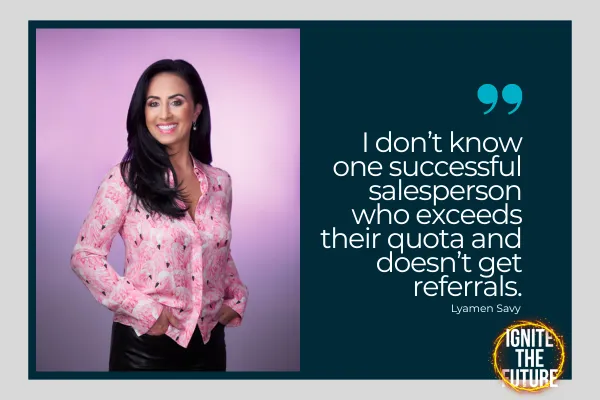
You already know referrals are valuable. You’ve probably told yourself you should be generating more of them. So why aren’t you, and what is that costing you? Lyamen’s answer is direct: “If you’re not building your referral pipeline, I don’t know what you’re doing in sales. I don’t know one successful salesperson who exceeds their quota and doesn’t get referrals. Referrals are everything.”
Every month spent working harder on internet leads, absorbing the friction, fighting the price pressure, closing at lower rates, is a month you’re not building a pipeline that compounds. Referral customers refer others. Introduction networks grow. The salesperson who starts building intentionally this month is in a fundamentally different
position twelve months from now than the one who keeps waiting for the dealership to fill the funnel.
The person who spent her early career making 80 cold calls a day built her entire company on never having to do that again. She knows exactly what it costs to generate business the hard way. And as marketing costs rise and paid lead generation becomes less efficient, the salespeople with established referral pipelines will have a structural advantage that only grows over time. This is not a tactic. It is a competitive position.
You’re not just leaving referrals on the table. You’re leaving income, pipeline, and long-term career leverage on the table.
Be in the Room: Lyamen Savy at the 2026 Women In Automotive Annual Conference

Lyamen Savy’s session is one of the most practical and immediately applicable at the 2026 Women In Automotive Annual Conference—designed for anyone in sales who wants to stop waiting for the dealership to build their pipeline and start building it themselves. You’ll walk in knowing referrals matter. You’ll walk out knowing exactly how to generate them consistently.
The 2026 Women In Automotive Annual Conference takes place July 17–20 in Austin, Texas, bringing together women across automotive careers, from dealership sales and leadership to OEMs, technology companies, and beyond, for the sessions that drive real results. Registration and details are available at womeninautomotive.com. Stop waiting. Start building. Lyamen’s session is where that starts.