
Data Hygiene in Automotive
How Dirty Data Is Costing Dealerships Revenue
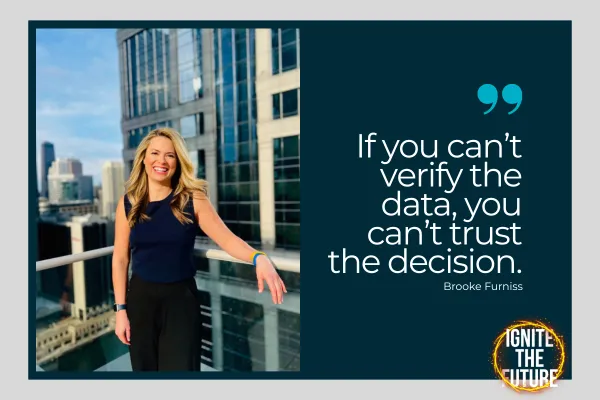
Someone walks into your office and tells you you’re up 10%. The dashboard looks good. The vendor report looks good. Everything, on the surface, looks good. For women in automotive leadership, already navigating rooms that scrutinize every number they present, the pressure to accept that story and move on is real. You nod. You move to the next agenda item. And somewhere in the back of your mind, something doesn’t quite add up. That feeling isn’t doubt. It’s data instinct. And if you’ve been ignoring it, Brooke Furniss wants you to stop.

Brooke spent nearly 20 years inside automotive, sitting in just about every seat a dealership has to offer, and that feeling followed her everywhere she went. The numbers people were celebrating didn’t match the reality she was seeing underneath them. “I just got so tired of people coming in like, hey, you’re crushing, you’re up 10%,” she says. “No, we’re not. The reach is down.” Most people in that situation learn to live with the discomfort. Brooke built a company out of it. BZ Consultants Group—the firm she founded and leads as CEO—exists entirely to answer the question she kept asking in every leadership meeting she ever sat in: what’s actually behind that number?
She’s bringing that question, and a few years’ worth of answers that will make your stomach drop, to the C-Suite Pre-Conference Event at the 2026 Women In Automotive Annual Conference in Austin this July. Her session covers data hygiene, vendor accountability, and the hidden costs of dirty data. She also hosts the podcast Facts, Not Feelings. The title is on-brand. If you’ve spent any time in a room with Brooke Furniss, you already know she doesn’t deal in comfortable fictions. Her session is shaping up to be one of the most practically useful hours of the pre-conference program—and one of the most eye-opening for any C-level leader who assumed their numbers were telling them the full story.
Dirty Data Isn’t a Marketing Problem—It’s a Revenue Problem
Here’s something worth sitting with: statistically, up to 40% of the information in your DMS or CRM right now is inaccurate. Not a little off. Not slightly stale. Wrong addresses. Vehicles customers traded in years ago. Email addresses they gave to the service lane and never check. Contacts for people who moved, opted out, or simply stopped existing in your market, and your system never got the memo. That 40% is baked into every campaign you ran this quarter, every mailer you sent last month, every retargeting dollar you spent this morning.
Brooke has watched this play out across clients of every size and market, and she’s done with softening the math. “If you look at it from a mailers perspective, mailers are not cheap. That means 40% of your budget is reaching no one. Drop $10,000 on a mailer, maybe it’s $20,000, maybe it’s $30,000, and you’re only reaching 60% of your intended audience.” The same logic runs through digital: retargeting campaigns built on bad emails, ad spend going to the wrong zip codes, texts landing in inboxes that haven’t been opened since a previous area code.
She’s lived it herself. The dealership where she bought her car, and then traded it in, still sends her service reminders for a vehicle she no longer owns. Every single one of those messages is a small, quiet signal to a customer: we don’t actually know you. “You are not reaching who you think you’re reaching,” she says. It’s not an accusation. It’s a diagnosis.
And when mail gets returned? “Who goes and looks at that pile?” Brooke asks. “Because it’s a large pile.” The answer, in most dealerships, is no one.

Clean data also reveals what dirty data buries, and some of it is genuinely surprising. Brooke has found time and again that dealerships dramatically underestimate their actual geographic reach. Most assume their customers live within 10 to 20 miles. The reality? She’s seen more customers coming from 50 miles or beyond than from the 30- to-40-mile range many dealers treat as their outer edge. That’s not just a data point. It’s a marketing strategy waiting to be built. Clean data doesn’t just fix what’s broken, it shows you opportunities the noise was drowning out.
Data hygiene isn’t a line item in the marketing budget. It’s the foundation every other budget line is sitting on.
The Vendors Saying All the Right Things—and Delivering Something Else
Here’s what makes Brooke’s frustration so specific, and so useful: she’s not railing against vendors in the abstract. She has sat through the demos. She has read the contracts. She has run the independent verification. And she has arrived at a conclusion that the industry mostly talks around: the gap between what vendors claim they deliver and what they actually deliver is enormous and most dealerships are paying for the claim.
Take push-pull DMS and CRM integration, a term that gets dropped in sales meetings with the casual confidence of something that has long since been solved. Brooke is not impressed. “The companies that can actually do push-pull integration is so minuscule,” she says. “When someone says that, immediately a red flag goes off.” She knows the short list of companies that can actually do it because she’s done the homework to build it. When a vendor claims otherwise, she already knows the answer before the demo ends.
She has a case study she returns to often because it captures the problem so cleanly. A large dealership group was paying a vendor to hygiene their data, actively, contractually, on an ongoing basis. A second company came in and ran the initial reports. They found they could add another 40% of valid email addresses to what the first vendor had produced. Forty percent. The group had been paying for a service. The service wasn’t being delivered. And because no one was independently verifying the results against any external benchmark, no one knew. The vendor’s dashboard showed everything was fine. It was not fine.
That story is frustrating. The next one is worse. When Brooke starts talking about website traffic attribution, her tone shifts slightly, not louder, just more deliberate, the way someone sounds when they’re about to say something the room needs to hear whether it wants to or not. She’s seen dealership traffic reports where the “backyard” dashboard looked clean and local. Then she pulled the raw data. Number two on the list wasn’t a nearby suburb. It was a country outside the United States. The pretty dashboard didn’t show that. It never does. And the practice of vendors buying low-quality bot traffic from overseas to artificially inflate site numbers? She doesn’t hesitate. “More common than you think. I will tell you that is more common.” The receipts exist. She has seen them.
This is the work BZ Consultants Group was built to do. They don’t sell advertising. They don’t take kickbacks. They don’t have a product riding on any particular outcome. Their value is entirely in the audit, going in, looking at what’s actually happening versus what’s being reported, and telling the truth. “Inspect what you expect” isn’t a catchy phrase. It’s the whole company.
“If you cannot independently verify any of that information,” she says of the dashboards vendors bring into dealership leadership meetings, “to me, it’s complete BS. I don’t know what is actually behind the scenes.” A beat. “That wizard behind the curtain.”
A dashboard that can’t be independently verified isn’t a performance report. It’s a story someone is telling you about your own business.
Own Your Data—or Someone Else Will
If there’s a hill Brooke Furniss is willing to die on, it’s this one, and she’ll tell you so directly. “I don’t know how in 2026 we are still having this conversation. There’s a hard stop. You should own your data.” She’s said it in enough rooms, to enough groups, that the repetition has stopped surprising her. The problem hasn’t.
Here’s how it typically unfolds. A dealership brings on an agency, marketing, data hygiene, digital, some combination, and somewhere in the contract, buried in the service agreement, is language about data access and retention. No one flags it at signing because everyone is focused on the deliverables. The relationship runs well for a year or two. Then something shifts: the results plateau, leadership changes, a better option comes along, or the relationship just sours the way vendor relationships sometimes do. The dealership decides to move on. And then the question gets asked for the first time: what happens to our customer data? The answer, in more cases than Brooke can count, is that it doesn’t come with you. The agency owns it. They built it on their infrastructure, using their tools, under their terms. The dealership was never really the owner, they were the renter. “You’re renting your data from them and they own it the entire time.”

The fix requires a direct conversation most dealerships avoid: Who owns this data? What happens to it if we part ways? Can we access the raw data at any time, independently, without routing through your dashboard? If the answers are unclear, evasive, or unfavorable that’s the answer. And it’s better to have that conversation before you sign than after you’ve decided to leave.
You can’t control what you don’t own. And in automotive, your customer data is one of the most valuable assets in the building.
AI Tools and Dealership Data: Why Clean Data Is the Missing Piece
Brooke uses AI the way most data-driven professionals have come to: constantly, gratefully, and with both eyes open. ChatGPT and Claude run in the background while she works. She’ll tell you without hesitation that she’d need two or three full teams to replicate what those tools do for her operation. She is not here to relitigate whether AI is useful. That conversation is over. The one she wants to have instead is the one the industry keeps skipping: useful AI starts with clean data, and most dealerships don’t have it.
The failure mode isn’t the technology. it’s the input. She’s watched AI tools repeat the same errors indefinitely because no one corrected the underlying data they were trained on. She’s seen dealership websites where every page reads identically to twenty competitors because everyone fed the same prompt to the same tool and accepted the output without a second look. She’s tracked attribution reports where AI-produced dashboards directed real budget decisions based on data that was, in her words, “factually not factual.” The AI was confident. It was also wrong. Nobody checked.
What she’s seen actually work is the combination: clean data, AI tools, and a human in the loop who understands both well enough to know when something doesn’t look right. Clients who’ve done the hygiene work first and then layered in conversational AI are hitting email open rates of 50% or more, compared to the 20% that passes for a win out of a standard CRM. The technology didn’t change. The data did. That’s the whole story.

On fully AI vendor solutions with no human oversight, she’s characteristically blunt: “Is that as factual as if a human actually looked at this?” It’s not a rhetorical question. It’s the one she’d recommend asking out loud, in the room, before signing anything.
AI accelerates what you already have. If what you have is a mess, AI will accelerate that too.
Hear Brooke Furniss at the 2026 Women In Automotive C-Suite Pre- Conference Event
Remember that number, the one on the dashboard that looked fine but felt off? Brooke Furniss is going to show you exactly where it came from, what it’s actually worth, and what to do about it. Her session at the 2026 Women In Automotive C-Suite Pre- Conference Event is for any C-level leader who has ever sat through a vendor
presentation quietly wondering if the numbers were real and for anyone who hasn’t started wondering yet but should be. Walk in knowing something is off. Walk out knowing exactly what to fix and how to start.
The C-Suite Pre-Conference Event is an exclusive gathering for C-level leaders held ahead of the 2026 Women In Automotive Annual Conference in Austin this July— bringing together the executives and decision-makers who shape the direction of automotive organizations. The answers to the questions your vendors don’t want you asking are on the table. Registration and details are available at womeninautomotive.com. Come ready to ask harder questions and leave with the tools to get honest answers.